
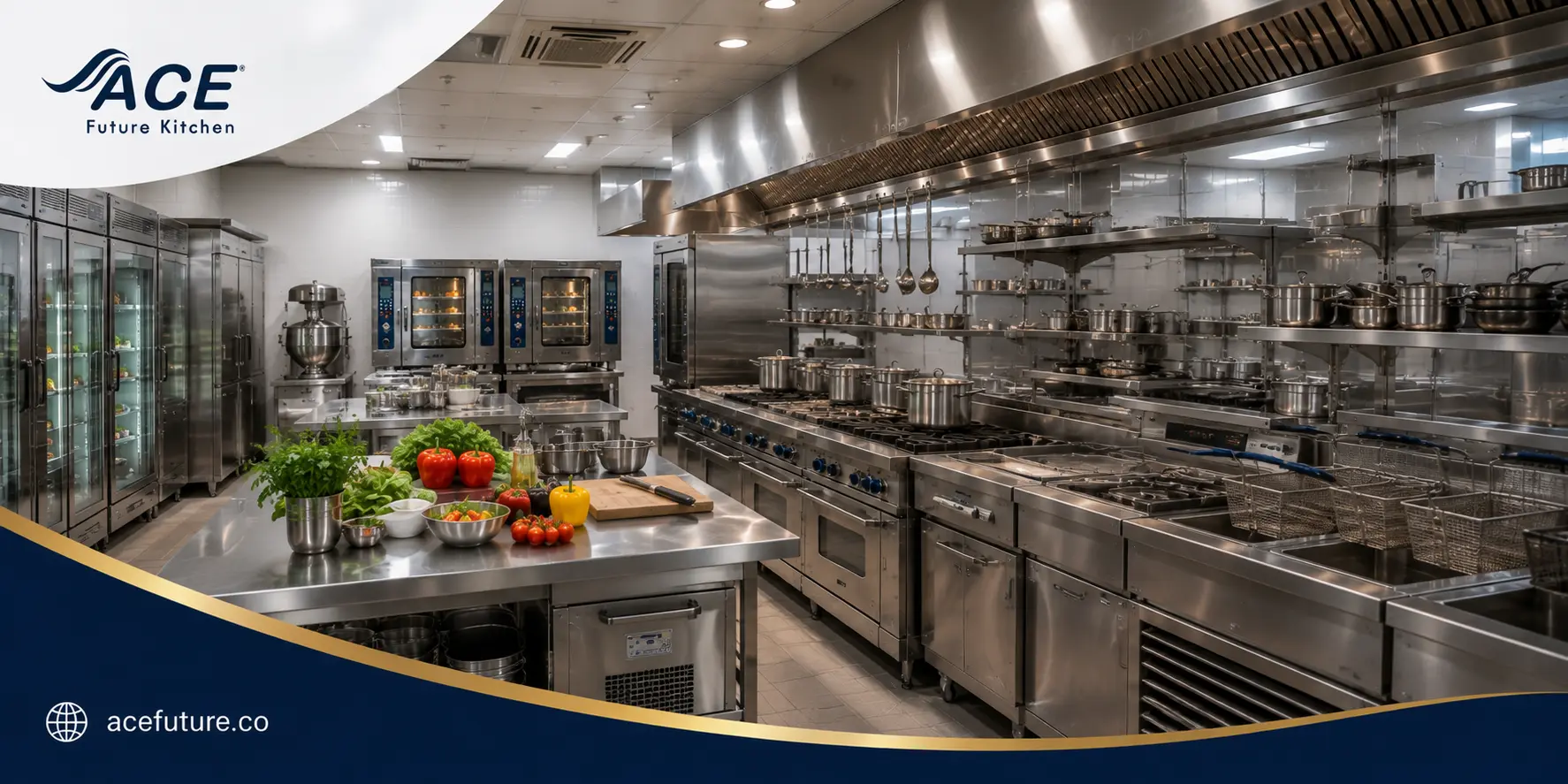
Opening a restaurant in Saudi Arabia involves dozens of decisions, from choosing the location and finalising the menu to hiring staff and preparing the kitchen. Choosing the right commercial kitchen equipment supplier is one of the decisions that can directly affect your opening timeline, budget and day-to-day operations.
The right supplier should do more than deliver ovens, refrigerators and cooking equipment. Restaurant owners should also consider equipment selection, kitchen layout requirements, installation, commissioning, compliance documentation, warranty coverage and after-sales support.
For first-time restaurant owners especially, having one supplier who can help coordinate these requirements can make the kitchen setup considerably easier.
This guide compares three commercial kitchen equipment suppliers serving restaurant businesses in Saudi Arabia and explains what restaurant owners should look for before requesting a quotation.
What Restaurant Owners Need That Hotels and Hospitals Don’t
Restaurant kitchens have different requirements depending on the concept, menu, expected covers and available space.
A café may need commercial coffee equipment, refrigeration and light cooking equipment, while a full-service restaurant may require a complete cooking line, preparation equipment, refrigeration, warewashing and ventilation.
When comparing a restaurant kitchen equipment supplier in Saudi Arabia, look at five areas.
Equipment should be selected according to what you actually plan to cook and how many customers you expect to serve.
A supplier should be able to discuss:
Buying equipment simply because it is available or heavily discounted can create unnecessary costs and capacity problems later.
First-time restaurant owners often need a commercial kitchen equipment package for a restaurant startup in Saudi Arabia rather than dozens of unrelated product quotations.
A good quotation should clearly separate:
This makes it easier to compare suppliers on the actual project cost rather than the equipment price alone.
Ask whether the supplier provides installation or only delivery.
For a new restaurant, professional installation can include positioning equipment correctly, coordinating utility connections, testing the equipment and confirming that the kitchen is ready for operation.
Restaurant owners importing or purchasing commercial equipment should confirm the applicable Saudi conformity requirements before ordering.
Depending on the equipment category, this may involve SABER, SASO requirements, energy-efficiency requirements or other applicable regulations.
The supplier should be able to explain which documents apply to the specific equipment being quoted.
Equipment problems do not stop because a restaurant has opened.
Before signing a quotation, ask:
For a new restaurant without an internal maintenance department, these questions are particularly important.
If this is your first restaurant, here is what matters most when comparing a restaurant equipment supplier for new business owners Saudi Arabia.
The following suppliers have different strengths, so restaurant owners should compare their services against their own project requirements rather than treating every supplier as identical.
| Supplier | Main Focus | Restaurant Equipment | Installation / Project Support | After-Sales |
| Ace Future Kitchen | Complete commercial kitchen solutions | Kitchen, bakery, refrigeration and related equipment | Supply, installation, testing and commissioning | Maintenance and support |
| Colombus Kitchen | HORECA and commercial kitchen equipment | Restaurant, café, bakery and catering equipment | Depends on product/project | Customer support |
| Your Kitchen Center | Commercial equipment catalogue and online purchasing | Cooking, refrigeration, beverage, preparation and other equipment | Product/service dependent | Brand and supplier dependent |
Service scope can vary by equipment and project. Restaurant owners should confirm installation, delivery, warranty and maintenance terms in the quotation.
Ace Future Kitchen is a commercial kitchen equipment supplier in Saudi Arabia serving restaurant, hospitality and institutional projects.
Established in 2000, the company provides equipment across commercial kitchens, bakery operations, refrigeration, laundry and related foodservice requirements.
For restaurant owners, the main advantage of working with a project-focused supplier is the ability to coordinate more than the equipment purchase itself.
Ace Future Kitchen’s services cover equipment supply, installation, testing and commissioning, with maintenance support available after handover.
The company also supplies bakery equipment in Saudi Arabia and provides broader commercial kitchen services.
Restaurant projects can also include refrigeration, cold rooms, stainless-steel kitchen requirements and other supporting systems.
Best suited for: Restaurant owners who want equipment supply combined with installation, commissioning and ongoing service support.
Before requesting a quotation, provide:
This gives the supplier enough information to recommend appropriately sized equipment rather than simply quoting a standard product list.
Colombus Kitchen is a Riyadh-based supplier serving the HORECA sector, including restaurants, cafés, bakeries and catering businesses.
Its product offering covers a range of commercial kitchen and hospitality equipment, with recognised brands available across different categories.
For restaurant owners, Colombus Kitchen can be relevant when comparing individual equipment requirements and commercial HORECA products.
Best suited for: Restaurants, cafés, bakeries and catering businesses looking for commercial kitchen and HORECA equipment.
When comparing a quotation, restaurant owners should confirm whether installation, commissioning, delivery and after-sales service are included for their particular order.
Your Kitchen Center provides commercial kitchen equipment through an online product catalogue serving the Saudi market.
Its range includes categories such as cooking equipment, ovens, refrigeration, food preparation, dishwashing, coffee and beverage equipment.
This can be useful for restaurant owners who want to compare individual commercial equipment products and brands.
Best suited for: Restaurant and cafe operators looking for a broad selection of commercial equipment and individual products.
Because service requirements can differ by product, buyers should confirm installation, delivery, warranty and maintenance arrangements before finalising an order.
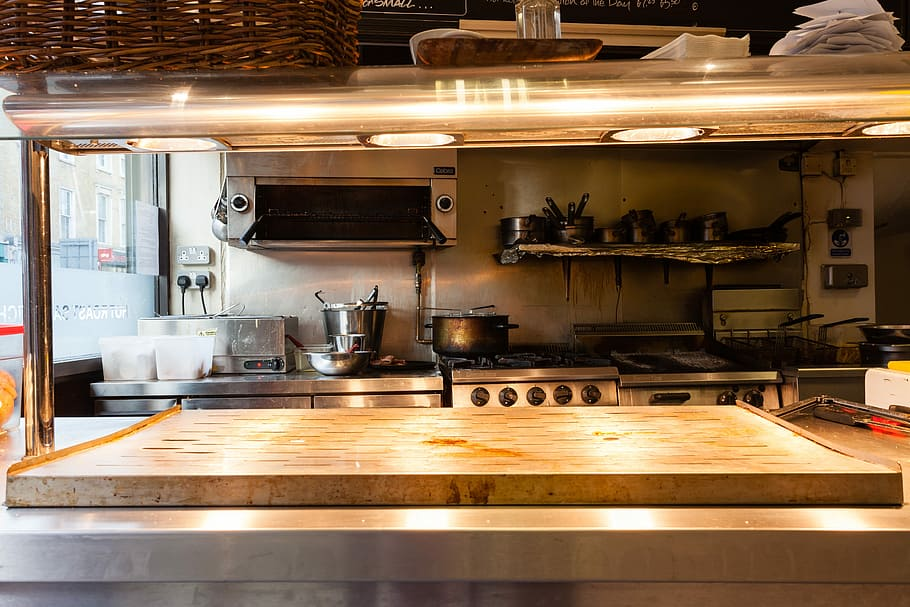
A commercial kitchen equipment package for restaurant startup KSA usually falls into these core categories. Use this as a baseline when requesting quotes.
| Category | Typical Equipment | Notes |
| Cooking line | Ranges, fryers, grills, ovens | Sized to your menu and covers per service |
| Refrigeration | Undercounter fridges, walk-in coolers | Confirm capacity matches storage needs |
| Food prep | Prep tables, mixers, slicers | Stainless steel preferred for durability |
| Warewashing | Dishwashers, sinks | Choose based on daily cover volume |
| Bakery, if applicable | Deck or convection ovens, proofers | Relevant for cafés and bakeries |
A startup restaurant does not necessarily need every piece of equipment available in a commercial kitchen catalogue.
The equipment list should be built around the restaurant’s menu, production volume and kitchen workflow.
A basic restaurant equipment plan commonly includes the following.
| Kitchen Zone | Typical Equipment | What to Consider |
| Cooking | Range, fryer, griddle, oven, induction equipment | Menu and peak covers |
| Preparation | Work tables, slicer, mixer, food processor | Preparation volume |
| Refrigeration | Upright refrigerator, freezer, prep counter | Daily storage requirements |
| Washing | Sink, dishwasher, pot-washing area | Number of covers |
| Storage | Shelving, racks, dry storage | Available space |
| Bakery | Oven, mixer, proofer, sheeter | Only where bakery production is required |
| Beverage | Coffee machine, grinder, blender, ice maker | Café and beverage menu |
| Exhaust | Hood and ventilation system | Cooking equipment and building requirements |
The exact equipment list should be developed from the restaurant’s menu and approved kitchen layout.
For a more detailed planning process, link this section to your existing guide on how to plan a commercial kitchen for a restaurant in Saudi Arabia.
There is no reliable single price for a restaurant kitchen because equipment costs can vary substantially according to the restaurant concept, kitchen size, production volume, equipment brand and installation requirements.
For example, a small café with limited cooking may require a very different equipment package from a 150-seat full-service restaurant.
Instead of asking only for the cheapest commercial kitchen equipment supplier, ask suppliers to provide an itemised quotation based on the same equipment specification.
Your comparison should include:
This provides a more realistic picture of the total cost of opening the kitchen.
Restaurant owners understandably want an affordable kitchen equipment supplier, particularly when opening their first location.
However, the cheapest initial quotation is not necessarily the lowest-cost solution over the life of the restaurant.
Consider the total cost of ownership:
Purchase price + installation + energy consumption + maintenance + spare parts + downtime
A low-cost piece of equipment that frequently breaks down can cost more than a better-supported commercial unit.
At the same time, the most expensive brand is not automatically the right choice. Equipment should be selected according to the restaurant’s actual production requirements and budget.
A good supplier should be able to explain why a particular model is appropriate rather than simply recommending the highest-priced option.
Compliance should be discussed before equipment is purchased, not after it arrives at the restaurant.
SABER requirements vary according to the product and applicable Saudi technical regulations. Restaurant owners should therefore ask suppliers to identify the specific conformity requirements applicable to each equipment category.
Before placing an order, request:
Do not assume that a supplier’s general statement that equipment is “SABER compliant” automatically covers every product in an order.
For a detailed explanation, link this section to your dedicated SABER commercial kitchen equipment rules 2026 guide.
A restaurant cannot easily stop operations while waiting several weeks for a replacement part.
This makes after-sales service an important part of the supplier comparison.
Before signing, ask each supplier:
Find out whether the supplier has its own technicians or relies on third parties.
Local stock can reduce equipment downtime compared with waiting for parts to be imported.
Scheduled maintenance can identify problems before they become operational failures.
An annual maintenance contract can provide restaurant owners with a defined service arrangement after the warranty period.
Get the warranty process in writing, including exclusions and response procedures.
For more information, link to your commercial kitchen maintenance services in Saudi Arabia.
It can.
A restaurant owner opening one location may only need local delivery and installation. A restaurant group expanding across Saudi Arabia has different requirements.
If you plan to open branches in Riyadh, Jeddah, Dammam or other cities, ask whether the supplier can provide consistent support across locations.
Using one supplier can potentially simplify:
Ace Future Kitchen provides project support across major Saudi markets, making geographic coverage an important part of the company’s offering for restaurant groups.
You can showcase relevant completed work through the Ace Future Kitchen projects page.
Before choosing a supplier, ask all shortlisted companies for quotations based on the same requirements.
Use this checklist:
| Question | Why It Matters |
| Does the supplier understand my menu? | Prevents incorrectly sized equipment |
| Is installation included? | Avoids unexpected contractor costs |
| Is testing and commissioning included? | Ensures equipment is ready for operation |
| What compliance documents are provided? | Reduces regulatory and import risk |
| What brands are available? | Determines quality and service options |
| Are spare parts locally available? | Reduces downtime |
| What warranty is provided? | Protects the investment |
| Is maintenance available? | Supports long-term operation |
| Can they support multiple cities? | Useful for restaurant expansion |
| Is the quotation itemised? | Makes supplier comparison easier |
The most useful comparison is not simply Supplier A vs Supplier B vs Supplier C.
It is:
What exactly will each supplier deliver, install, certify and support for the total quoted price?
Restaurant owners need a supplier who understands the pressure behind a new opening.
At Ace Future Kitchen, our approach covers the project from equipment selection through installation and handover.
Our services include:
We have been serving commercial kitchen projects since 2000 and support businesses across Saudi Arabia.
For restaurant owners planning a new location, the best starting point is to provide the menu, kitchen drawings, expected covers, location and target opening date. This allows the equipment package to be developed around the actual restaurant rather than a generic catalogue.
To discuss your project, visit our contact page.
Choosing a commercial kitchen equipment supplier is one of the practical decisions that can have a direct impact on a restaurant’s opening and ongoing operations.
Restaurant owners should compare more than equipment prices. Look at equipment suitability, installation, commissioning, compliance documentation, warranty, spare parts, maintenance and the supplier’s ability to support the business after opening.
For a first-time restaurant owner, a supplier that can explain the equipment requirements and coordinate installation and support can also simplify the process of turning an empty kitchen into an operational one.
Whether you are opening a café in Riyadh, a restaurant in Jeddah or expanding a food business into Dammam, use the same comparison criteria for every supplier and request an itemised quotation before making a decision.
Look for a supplier that can recommend equipment according to your menu, covers and kitchen layout. Also compare installation, commissioning, compliance documentation, warranty, spare parts and after-sales support.
A package can simplify procurement and may provide more efficient pricing, delivery and installation. However, restaurant owners should compare the complete scope and total price rather than assuming that a package is automatically cheaper.
Ask each supplier to quote against the same equipment list and specifications. Compare equipment, delivery, installation, commissioning, compliance documents, warranty, maintenance and spare-parts support.
The cost depends on the restaurant concept, menu, kitchen size, expected covers, equipment brands and installation requirements. An itemised quotation based on the restaurant’s actual requirements is more useful than a generic average price.
Yes. A project-focused supplier can help prioritise essential equipment and select models based on the restaurant’s expected production volume and budget.
Some suppliers provide installation, while others primarily sell and deliver equipment. Always confirm whether installation, testing and commissioning are included before comparing quotations.
Request the applicable conformity documentation, product specifications, model numbers, warranty terms, installation scope and itemised quotation. SABER and SASO requirements should be verified according to the specific product category.
Some suppliers have multi-city project and service capabilities. Restaurant groups planning multiple branches should confirm installation, maintenance, warranty and spare-parts coverage in each location before signing.
A typical setup may include cooking equipment, refrigeration, preparation tables, food preparation equipment, sinks or dishwashing equipment, storage and ventilation. Bakeries and cafés may require additional specialist equipment.
No. Consider purchase price together with energy consumption, installation, maintenance, spare parts, warranty and expected downtime. The lowest quotation may not have the lowest overall operating cost.

With 38 years of experience in the industrial kitchen and laundry business, our Co-founder began his career as a Sales Manager in 1986 and later became the CEO of a major kitchen and laundry contractor in KSA in 1999.
Top 3 Commercial Kitchen Equipment Supplier in Saudi Arabia for Restaurant Owners
July 30, 2026
Top 5 Commercial Kitchen Equipment Supplier in Saudi Arabia (2026 Comparison)
July 27, 2026
Top 3 Kitchen and Laundry Equipment Contractor in Saudi Arabia: What to Check Before You Sign
July 17, 2026