
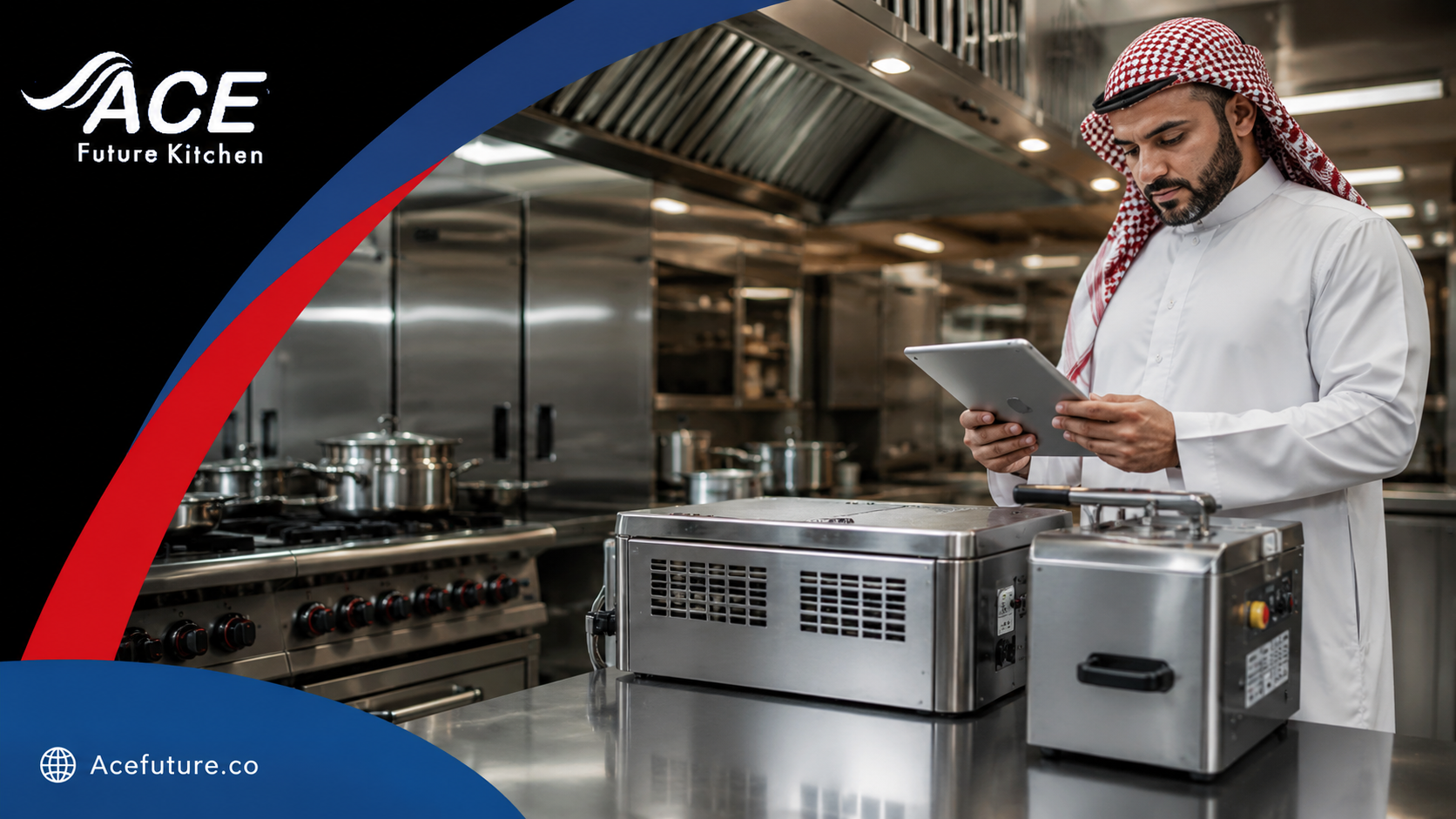
Opening a restaurant, café, hotel, catering facility, or central kitchen in Saudi Arabia is an exciting opportunity, but choosing the right commercial kitchen equipment requires more than comparing prices and specifications.
Imported and locally supplied equipment may be subject to Saudi technical regulations, conformity requirements, product labelling requirements, and other applicable standards depending on the product category.
This is where SABER commercial kitchen equipment rules 2026 become important.
SABER is Saudi Arabia’s electronic platform for product registration and conformity-related processes. The applicable technical requirements are determined by the relevant Saudi technical regulations and standards.
At Ace Future Kitchen, we supply and install commercial kitchen, bakery, laundry, cold room, and related equipment across Saudi Arabia. We help clients manage equipment supply, installation, testing, commissioning, maintenance, and after-sales support.
In this guide, we explain the SABER kitchen equipment requirements in Saudi Arabia, the difference between SABER and SASO, food-contact requirements, conformity certificates, 2026 regulatory updates, and what restaurant owners should check before purchasing or importing equipment.
SABER is Saudi Arabia’s electronic platform used for product registration and conformity-related services.
The platform supports processes involving applicable regulated products, including product conformity certificates and shipment certificates.
However, SABER and SASO are not the same thing.
SASO, the Saudi Standards, Metrology and Quality Organization, develops Saudi standards and technical regulations.
SABER is the electronic platform used to register products and manage applicable conformity procedures.
The technical regulation that applies to a commercial kitchen product depends on factors such as the product category, intended use, classification, and applicable Saudi requirements.
This distinction is important when researching commercial kitchen equipment regulations in Saudi Arabia.
Not every commercial kitchen product automatically follows the same SABER certification process.
The applicable requirements depend on the product and the Saudi technical regulation that covers it.
Commercial kitchen equipment can include:
Before importing or purchasing equipment, businesses should identify the product, HS code, applicable technical regulation, and required conformity procedure.
This is particularly important for businesses importing equipment into Saudi Arabia because incorrect documentation can create delays during the import and customs process.
Food-contact equipment is an important part of commercial kitchen equipment compliance in Saudi Arabia.
SASO has a Technical Regulation for Food Safety of Tools and Appliances Used in the Kitchen. The regulation addresses tools and appliances that are already in contact with food or can reasonably come into contact with food during preparation, serving, and storage.
Examples include:
The objective is to help prevent harmful substances from migrating from materials or equipment into food.
Depending on the product and applicable requirements, suppliers may need to provide documentation such as:
Businesses should confirm the exact documentation required for their specific equipment rather than assuming that every food-contact product follows an identical certification process.
Commercial kitchen equipment can be subject to different Saudi technical requirements depending on the product category.
For example, certain electrical appliances and energy-consuming equipment may be subject to energy-efficiency requirements.
Products commonly used in commercial kitchens can include:
For each product, the importer or supplier should verify the applicable technical regulation and current conformity requirements before placing an order.
Saudi Arabia has introduced updated energy-efficiency standards for certain low-voltage electrical products.
Updated standards including SASO 2663:2025 and SASO 2874:2025 are scheduled for mandatory enforcement from 1 December 2026 for products covered by those standards.
This means manufacturers, exporters, importers, and commercial kitchen equipment buyers should review the specifications and conformity requirements of affected products before the enforcement date.
The update does not mean that every commercial kitchen appliance automatically falls under the same energy-efficiency standard. The applicable requirement depends on the product category and relevant technical regulation.
For businesses purchasing refrigeration, electrical cooking equipment, or other energy-consuming equipment, checking the applicable requirements before procurement can help prevent compliance and import problems.
The third part is the paperwork that lets goods enter the country. SABER certification for food service equipment works through two certificates. The Product Certificate of Conformity (PCoC) is issued for each product model and is valid for one year. The Shipment Certificate of Conformity (SCoC) is issued for each shipment and is needed for customs clearance.
Without these, your chillers, ovens, or exhaust hoods can be held at the port. This is why SABER certification for food service equipment matters so much for restaurant owners who import equipment. Strong restaurant kitchen equipment compliance Saudi Arabia keeps your project on schedule and avoids costly delays.
How to Certify Kitchen Equipment in Saudi Arabia in 2026
Many restaurant owners ask:
How do I certify kitchen equipment in Saudi Arabia?
The exact process depends on the equipment and applicable technical regulation, but the general workflow is:
Collect the basic information about the equipment:
Determine whether the product is regulated and identify the Saudi technical regulation that applies to it.
Do not assume that all commercial kitchen equipment follows the same SABER process.
Depending on the product, you may need:
Where required, register the product and submit the relevant conformity information through the SABER platform.
For applicable regulated products, complete the conformity assessment process and obtain the relevant Product Certificate of Conformity.
For applicable imported shipments, complete the shipment certification process before customs clearance.
Keep relevant certificates, technical specifications, test reports, product information, and installation documents for your project records.
Starting this process before placing a large equipment order is preferable to discovering a documentation issue after the shipment has already arrived.t after the container lands.
The exact documents depend on the equipment and applicable technical regulation.
However, commercial kitchen equipment suppliers and importers may need information such as:
| Document | Purpose |
| Product name and model | Identifies the exact equipment |
| Manufacturer information | Identifies the product manufacturer |
| HS code | Supports product classification |
| Technical specification | Describes product performance and construction |
| Test report | Demonstrates applicable technical compliance |
| Material information | Important for food-contact products |
| Product photographs | Supports product identification |
| Energy-efficiency documents | Required for applicable products |
| Product Certificate | Required for applicable regulated products |
| Shipment Certificate | Required for applicable imported shipments |
| Installation documents | Supports correct installation and commissioning |
Always confirm the current documentation requirements for the specific product before shipment.
When you choose SABER-approved commercial kitchen equipment Saudi Arabia, you reduce risk from day one. We at Ace Future Kitchen supply from world-leading partners whose products already meet the right standards, so the SABER kitchen appliance certification requirements are simpler to clear.
We do not design kitchens or prepare layout. Our work begins from the approved drawings given to us, and we focus on supply, installation, testing and commissioning, maintenance, and after-sales support. You can see the full list on our services page, and view past work on our projects page.
To keep every job clear, our team records progress on a work report sheet inside a tracker sheet. This tracker shows the status of submittals, deliveries, installation, and testing for each area, so you always know where your project stands. This control is a key part of how we meet the SABER commercial kitchen equipment rules 2026 on site, and it supports strong restaurant kitchen equipment compliance Saudi Arabia from start to handover.
We handle many product types under one roof:
For smart and connected units, our guide on smart kitchen technology and IoT equipment explains the latest options, while our look at the top commercial kitchen trends in Saudi Arabia for 2026 shows where the market is heading.
Our commercial kitchen equipment solutions can include:
We supply and install cold rooms, freezer rooms, and walk-in refrigeration systems for commercial food businesses.
Explore cold room and freezer room installation.
Our bakery equipment range includes equipment such as:
Explore bakery equipment in Saudi Arabia.
Commercial kitchens require effective waste handling as part of daily operations.
Explore waste management solutions.
Correct installation is only the beginning. Equipment also requires regular inspection, cleaning, preventive maintenance, and servicing.
Learn about commercial kitchen equipment maintenance.
Commercial kitchen equipment buyers should review regulatory updates before purchasing or importing equipment.
Updated energy-efficiency standards for certain low-voltage electrical products are scheduled for mandatory enforcement from 1 December 2026.
Businesses purchasing affected products should check whether the equipment complies with the applicable updated standard before procurement.
SABER has also published updates concerning supplier name and commercial registration number labelling requirements for products covered by specified technical regulations.
The current SABER notice states that this requirement becomes mandatory from 1 October 2026 for products covered by the specified regulations.
Because the requirement applies to specified technical regulations rather than every product on the Saudi market, businesses should check whether their particular equipment category is affected.
Before purchasing or importing commercial kitchen equipment, use this checklist:
Different products can be subject to different technical regulations.
Conformity requirements should be checked before procurement and shipment.
Always collect the exact model, manufacturer, specifications, and relevant documentation.
Equipment that comes into contact with food requires appropriate consideration of materials and applicable food-safety requirements.
For applicable electrical products, check the current energy-efficiency requirements before purchasing.
Ask for the exact certificate and product information rather than relying only on a supplier’s general statement.
Compliance and safe operation also depend on appropriate cleaning, maintenance, servicing, and equipment performance.
The SABER kitchen equipment rules for restaurants Saudi Arabia exist to keep diners safe and the market fair. Strong SABER compliance for restaurant owners Saudi Arabia is not only about avoiding fines. Certified, energy-rated equipment lasts longer, uses less power, and keeps food safe. It also protects your brand if an inspector visits. Owners who ignore the SABER commercial kitchen equipment rules 2026 often face held shipments, failed inspections, and lost opening dates. To avoid common errors, read our note on kitchen equipment mistakes new restaurant owners make and our guide on installation quality.
If you are planning a new outlet, talk to us early. Our complete commercial kitchen solution covers the supply and fit-out of compliant equipment, and you can reach our team through the contact us page. With the right partner, meeting the SABER commercial kitchen equipment rules 2026 becomes a smooth, simple step in your project not a last-minute worry.

Ace Future Kitchen supplies and installs commercial kitchen, bakery, laundry, refrigeration, and related equipment across Saudi Arabia.
Our services include:
We work from approved project drawings and specifications and focus on supplying, installing, testing, and commissioning the required equipment.
For equipment subject to Saudi conformity requirements, we recommend confirming the applicable technical regulation and documentation before procurement.
View our commercial kitchen services or explore our commercial kitchen projects.
SABER commercial kitchen equipment requirements refer to the product registration and conformity procedures applicable to regulated equipment under Saudi technical regulations. The specific requirements depend on the product category, applicable technical regulation, classification, and intended use.
The requirements depend on the specific equipment. Food-contact equipment, electrical appliances, energy-consuming products, and other commercial kitchen products may be subject to different Saudi technical regulations.
Before importing equipment, verify the product classification, HS code, and applicable technical regulation.
Some commercial kitchen products are subject to Saudi conformity requirements and require SABER-related certification, while other products may not follow the same process.
The requirement should be confirmed based on the specific product and applicable technical regulation.
First identify the product and applicable technical regulation. Then prepare the required technical documentation, complete the applicable conformity assessment process through SABER, obtain the required product certificate, and complete the shipment certification process where applicable.
SASO is the Saudi Standards, Metrology and Quality Organization responsible for Saudi standards and technical regulations.
SABER is the electronic platform used for product registration and conformity-related processes.
A Product Certificate of Conformity is used for applicable regulated products to demonstrate compliance with the relevant Saudi technical requirements.
A Shipment Certificate is used for applicable imported shipments as part of the Saudi product conformity process.
Requirements vary by product. Depending on the applicable regulation, documentation can include product specifications, manufacturer information, test reports, technical files, product photographs, material information, and conformity documentation.
Updated energy-efficiency standards for certain low-voltage electrical products are scheduled for mandatory enforcement from 1 December 2026. Businesses should check whether their particular equipment is covered by the applicable updated standard.
SABER has announced supplier name and commercial registration number labelling requirements for products covered by specified technical regulations, with mandatory implementation from 1 October 2026.
The requirement should be checked against the specific product and applicable technical regulation rather than assumed to apply to every commercial kitchen product.
Ace Future Kitchen supplies, installs, tests, and commissions commercial kitchen equipment across Saudi Arabia. We work from approved project drawings and specifications and provide maintenance and after-sales support.
For the latest requirements, businesses should always verify the applicable regulations and conformity requirements through official Saudi sources.
Saudi Arabia’s official electronic platform for product registration and conformity-related services.
Visit the official SABER platform.
The Saudi Standards, Metrology and Quality Organization publishes Saudi standards and technical regulations.
The official SABER product conformity service provides information about the product certification process and applicable requirements.
View the SABER Product Certificate service.
Whether you are opening a restaurant, café, hotel kitchen, catering facility, bakery, or central kitchen in Saudi Arabia, checking equipment requirements before procurement can help prevent avoidable delays.
Ace Future Kitchen can support your project with commercial kitchen equipment supply, installation, testing, commissioning, maintenance, and after-sales support.

With 38 years of experience in the industrial kitchen and laundry business, our Co-founder began his career as a Sales Manager in 1986 and later became the CEO of a major kitchen and laundry contractor in KSA in 1999.
Top 3 Commercial Kitchen Equipment Supplier in Saudi Arabia for Restaurant Owners
July 30, 2026
Top 5 Commercial Kitchen Equipment Supplier in Saudi Arabia (2026 Comparison)
July 27, 2026
Top 3 Kitchen and Laundry Equipment Contractor in Saudi Arabia: What to Check Before You Sign
July 17, 2026