
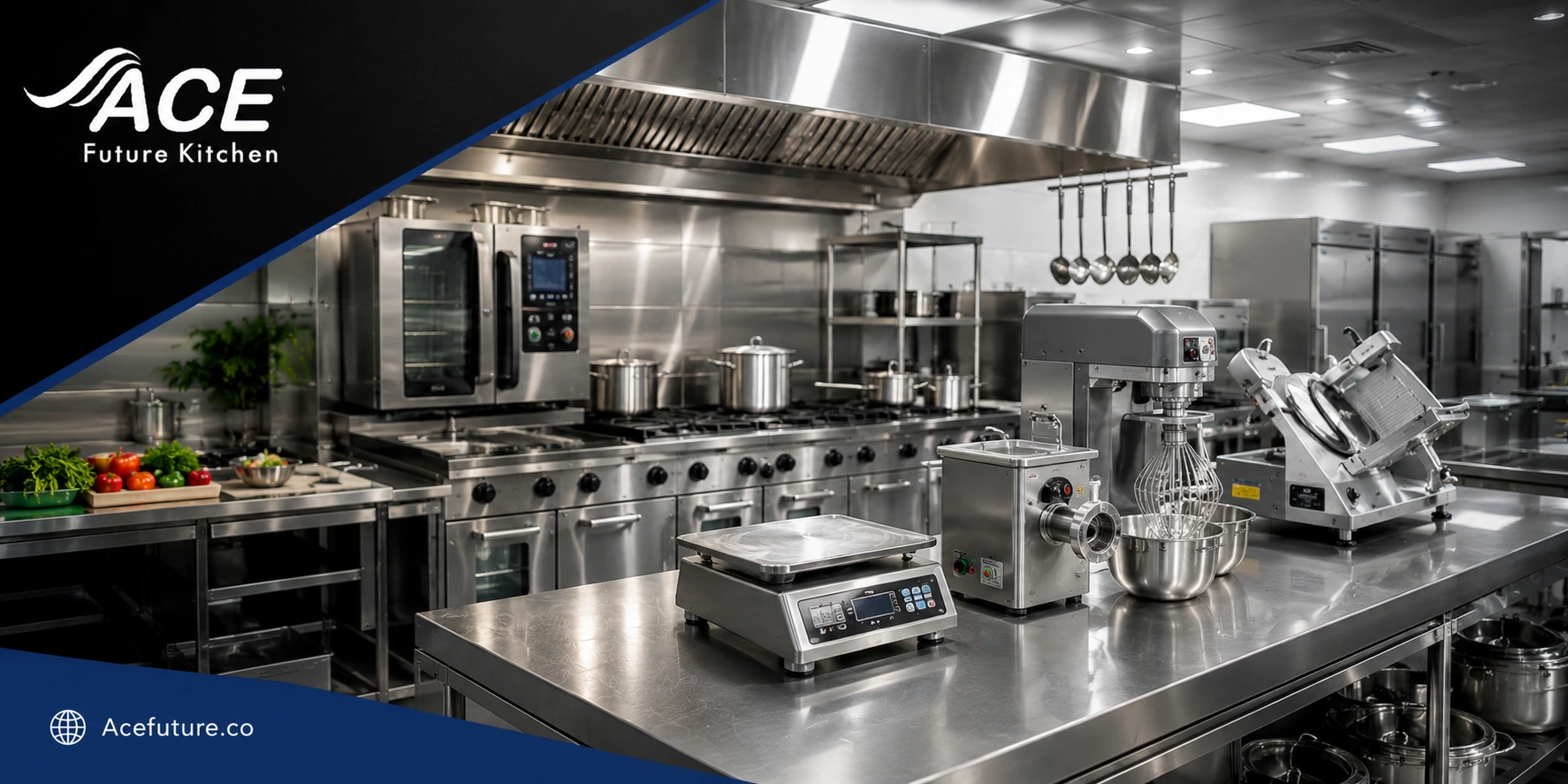
If you operate a restaurant, hotel, catering facility, central kitchen, hospital kitchen or other food business in Saudi Arabia, your commercial kitchen equipment needs to support applicable food safety and hygiene requirements.
Understanding the SFDA food safety requirements for commercial kitchen equipment in KSA is important when selecting cooking equipment, refrigeration systems, food preparation surfaces, storage equipment and other items that come into contact with food.
The Saudi Standards, Metrology and Quality Organization (SASO) has a specific Technical Regulation for Food Safety of Tools and Appliances Used in the Kitchen. The regulation applies to tools and equipment that are already in contact with food or can reasonably come into contact with food during preparation, serving and storage.
For equipment buyers, compliance is not simply about purchasing stainless-steel equipment. You also need to consider food-contact materials, hygienic design, cleaning, temperature control, documentation and the applicable product conformity requirements.
At Ace Future Kitchen, we supply and install commercial kitchen equipment for restaurants, hotels and food businesses across Saudi Arabia. Our team helps clients evaluate equipment requirements, documentation, installation, testing and commissioning before handover.
The Saudi Food and Drug Authority (SFDA) is responsible for food safety and related regulatory activities in Saudi Arabia. For commercial kitchens, food safety requirements affect how food is handled, prepared, stored and protected from contamination.
Equipment used in these processes should support safe food handling and hygienic operation.
Important areas include:
The specific requirements depend on the type and intended use of the equipment.
One of the most common sources of confusion for restaurant owners is the difference between SFDA, SASO and SABER.
The Saudi Food and Drug Authority (SFDA) is the authority associated with food safety, food products and food establishments in the Kingdom.
For a commercial kitchen, SFDA-related requirements focus on maintaining safe food handling and preventing contamination.
The Saudi Standards, Metrology and Quality Organization (SASO) develops and maintains Saudi standards and technical regulations.
SASO has a specific technical regulation titled Technical Regulation for Food Safety of Tools and Appliances Used in the Kitchen.
SABER is an electronic platform used for product registration and conformity-related processes for products entering the Saudi market.
The platform provides services including product registration, product conformity certificates and shipment certificates.
Therefore, these terms should not be treated as interchangeable:
SFDA = food safety authority
SASO = standards and technical regulations
SABER = conformity/product registration platform
This distinction is important when purchasing or importing commercial kitchen equipment.
The applicable requirements depend on the equipment, its materials, intended use and whether it comes into contact with food.
Common commercial kitchen equipment includes:
The SASO food-safety regulation specifically covers tools and equipment that are already in contact with food or can reasonably come into contact with food during preparation, serving and storage.
Food-contact materials are materials intended to come into contact with food during normal or foreseeable use.
These can include:
The SASO technical regulation defines food-contact materials and establishes requirements intended to prevent contamination from materials used in kitchen tools and appliances.
Before purchasing equipment, ask the supplier for information about:
Do not assume that every stainless-steel product automatically meets every requirement simply because it is made from stainless steel.
Stainless steel is widely used in commercial kitchens because it is durable, corrosion-resistant and relatively easy to clean.
Common applications include:
However, the appropriate material specification should be selected according to the equipment’s application and applicable requirements.
Instead of making a blanket claim that one stainless-steel grade is legally required for every commercial kitchen application, buyers should confirm the material specification against the applicable technical regulation and intended food-contact use.
This is particularly important for equipment manufactured outside Saudi Arabia.
Commercial kitchen equipment should be designed so that it can be cleaned, inspected and maintained effectively.
Important design considerations include:
Food-contact surfaces should be suitable for effective cleaning and sanitation.
Equipment should avoid unnecessary gaps, inaccessible areas and design features that allow food residue or moisture to accumulate.
Operators should be able to access relevant surfaces and components for routine cleaning and maintenance.
Equipment materials should be suitable for the operating environment and normal cleaning processes.
Equipment placement should support a kitchen workflow that reduces opportunities for cross-contamination.
These considerations are particularly important when designing preparation, cooking, washing and storage zones.
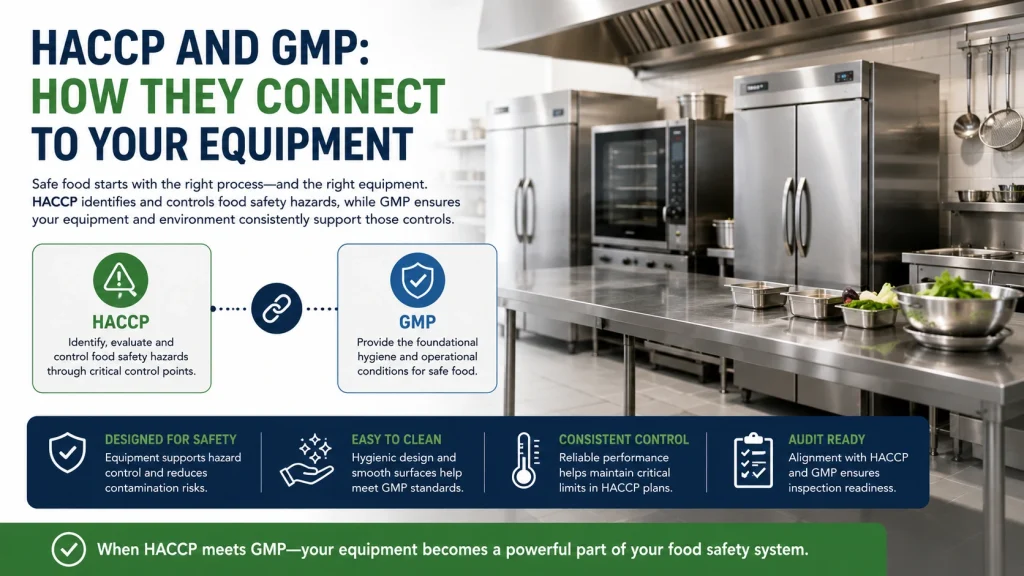
HACCP (Hazard Analysis and Critical Control Points) is a systematic approach to identifying and controlling food safety hazards.
Equipment selection can support HACCP controls by helping operators:
For example, refrigeration equipment should be capable of maintaining the temperatures required for the food operation, while cooking equipment should provide appropriate temperature control for the intended process.
HACCP should therefore be considered when specifying equipment, even though HACCP and product conformity certification are not the same thing.
Good Manufacturing Practices (GMP) provide principles for maintaining hygienic production and handling conditions.
For commercial kitchens, equipment should support:
The SASO technical regulation itself includes food-safety and good-manufacturing-practice concepts relevant to products covered by the regulation.
Commercial refrigeration is particularly important in Saudi Arabia because food businesses often depend on refrigeration, freezers and cold rooms for safe food storage.
When selecting refrigeration equipment, consider:
For large kitchens, cold rooms and freezer rooms should also be integrated into the overall food-storage workflow.
Before purchasing commercial kitchen equipment, ask the supplier to provide documentation relevant to the product.
Depending on the product, this may include:
SABER’s official platform states that importers can register products and conformity certificates and issue shipment certificates for commercial products subject to the applicable requirements.
Not every item should automatically be described as requiring the same SABER process.
SABER requirements depend on the applicable Saudi technical regulations and product classification.
For regulated commercial products, the SABER process can include product registration, conformity assessment and shipment certification. The official platform explains that conformity certificates are used to demonstrate compliance with the Saudi specifications and applicable technical regulation.
Therefore, before importing equipment, confirm:
For specific imported equipment, it is better to verify the product requirements rather than assuming that every commercial kitchen item follows exactly the same certification process.
Do not select equipment based only on price or appearance.
Ask what materials are used on surfaces and components that come into contact with food.
Material selection still needs to be considered against the applicable requirements and intended use.
Confirm the applicable technical regulation and SABER requirements before shipment.
Keep relevant product specifications, test reports and conformity documents with the project records.
Even compliant equipment needs to be installed correctly so that it can operate, be cleaned and be maintained properly.
Food safety compliance does not end when equipment is installed. Cleaning, preventive maintenance and equipment performance should continue throughout the equipment lifecycle.
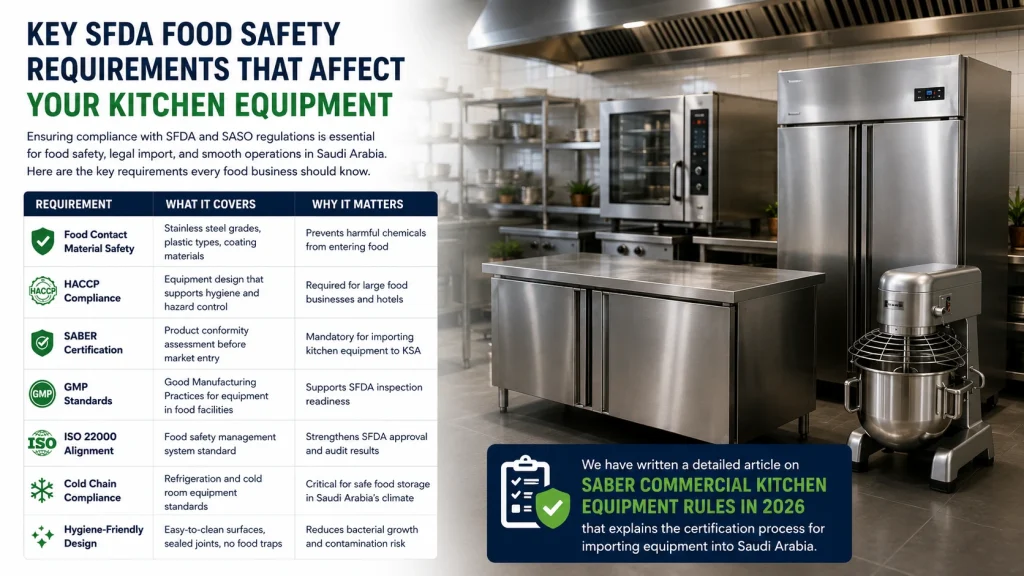
We have written a detailed article on SABER commercial kitchen equipment rules in 2026 that explains the certification process for importing equipment into Saudi Arabia.
Food contact materials are any materials that touch food directly during preparation, cooking, or storage. SFDA food safety compliance for kitchen equipment is largely about ensuring these materials are safe.
Common food contact materials in commercial kitchens include:
What SFDA and SASO require for these materials:
If you are buying kitchen equipment from overseas, the supplier must provide a test report confirming the materials meet SASO safety standards. Our team at Ace Future Kitchen checks all of this documentation as part of our equipment supply and testing process, so you do not have to manage compliance paperwork alone.
Many food business owners in Saudi Arabia make costly mistakes when buying commercial kitchen equipment. Here are the most common ones:
We also recommend reading our article on kitchen equipment mistakes new Saudi restaurant owners make to avoid the most common pitfalls before you invest.
We understand that navigating SFDA food safety requirements for commercial kitchen equipment in KSA can feel complicated, especially when you are focused on running your business. That is why we take care of the compliance side for our clients.
Here is what we do:
Our experience since 2000 means we know what SFDA inspectors look for and what equipment choices protect your business in the long term.

Commercial kitchen equipment should support safe food handling, hygienic operation, appropriate food-contact safety and applicable Saudi technical requirements. Equipment covered by the SASO Technical Regulation for Food Safety of Tools and Appliances Used in the Kitchen must meet the requirements applicable to that regulation.
SFDA is associated with food safety regulation and oversight, while SASO develops Saudi standards and technical regulations. SASO has a specific technical regulation covering food safety of tools and appliances used in kitchens.
SABER is Saudi Arabia’s electronic platform for product registration and conformity-related processes. It provides services including product registration, conformity certificates and shipment certificates for applicable products.
It depends on the product and the technical regulations applicable to it. Before importing, the buyer should identify the product classification, applicable technical regulation and required conformity route through SABER.
Food-contact equipment can use materials such as stainless steel, plastics, rubber, glass, ceramics and other materials. The appropriate material depends on the intended application and applicable food-contact requirements.
Stainless steel is widely used in commercial kitchens because of its durability and cleanability, but the required material specification depends on the equipment, application and applicable requirements.
Yes. Equipment can support HACCP controls through effective temperature control, hygienic design, cleanability, safe food flow and contamination prevention. HACCP itself is a food-safety management approach and should not be confused with a product conformity certificate.
Request the product specification, manufacturer information, model number, relevant food-contact documentation, test reports and applicable conformity certificates. For regulated imported products, also confirm the applicable SABER requirements.
Yes. Ace Future Kitchen supplies and installs commercial kitchen equipment for food businesses in Riyadh and across Saudi Arabia, including testing, commissioning and after-sales support.
For regulatory information, buyers should verify the latest requirements directly with the relevant Saudi authorities.
If you are opening a restaurant, hotel kitchen, catering facility or central kitchen in Saudi Arabia, selecting compliant equipment before procurement can help reduce problems during installation and commissioning.
Ace Future Kitchen can support your project with commercial kitchen equipment supply, installation, testing and commissioning across Saudi Arabia.
Contact Ace Future Kitchen to discuss your commercial kitchen equipment requirements.

With 38 years of experience in the industrial kitchen and laundry business, our Co-founder began his career as a Sales Manager in 1986 and later became the CEO of a major kitchen and laundry contractor in KSA in 1999.
Top 3 Commercial Kitchen Equipment Supplier in Saudi Arabia for Restaurant Owners
July 30, 2026
Top 5 Commercial Kitchen Equipment Supplier in Saudi Arabia (2026 Comparison)
July 27, 2026
Top 3 Kitchen and Laundry Equipment Contractor in Saudi Arabia: What to Check Before You Sign
July 17, 2026