
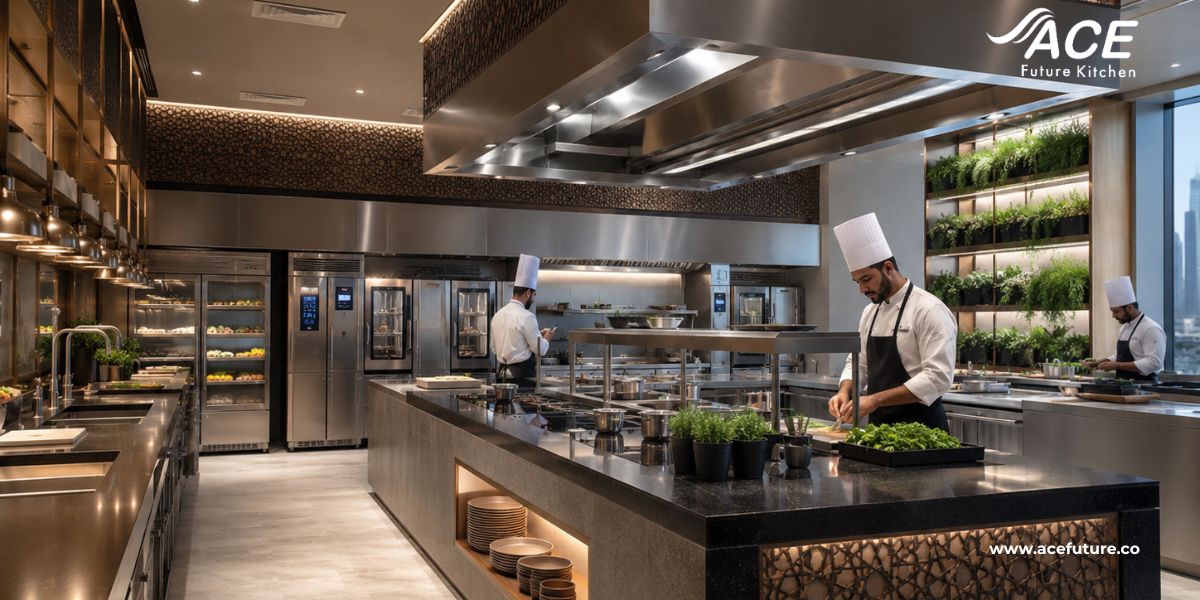
The food and hospitality industry in Saudi Arabia is growing at a pace never seen before. From massive giga-projects like NEOM and Red Sea Global to hundreds of new restaurants opening in Riyadh, Jeddah, and beyond, the demand for high-performance commercial kitchen equipment Saudi Arabia operators rely on has never been higher.
As we move through 2026, kitchen operators, hotel managers, restaurant owners, catering facility heads, and food service professionals are all asking the same question: what does the future of a commercial kitchen in Saudi Arabia look like?
This article covers the top commercial kitchen trends Saudi Arabia 2026, from smart technology and energy-efficient equipment to cloud kitchens, AI, sustainability, and large-scale industrial kitchen projects. It also explains what these trends mean for businesses investing in new kitchen setups or upgrading existing facilities.
Saudi Arabia’s continued investment in hospitality, tourism, entertainment and major development projects is creating new requirements for efficient, reliable and technology-enabled food service operations. Vision 2030 also places emphasis on economic diversification, tourism, digital transformation and sustainability.
For businesses planning a new restaurant, hotel, catering facility or central kitchen, understanding these trends can help with better equipment selection and long-term operational planning.
One of the biggest shifts happening right now is the rise of smart commercial kitchens. A few years ago, connected kitchen equipment was a luxury. In 2026, it is quickly becoming a standard expectation, especially in hotels, high-end restaurants, cloud kitchens, and large catering operations.
Smart kitchen equipment uses IoT (Internet of Things) technology to connect individual pieces of equipment to a central system. This means a combi oven can send an alert when it needs maintenance, a refrigeration unit can log its temperature history automatically, and a dishwasher can track its water usage over time.
For Saudi restaurant and hotel operators, this kind of connectivity does something very important: it reduces downtime. When a piece of equipment fails unexpectedly in the middle of service, it costs money, damages reputation, and puts pressure on kitchen staff. Smart equipment gives operators advance warning before problems become serious.
This is exactly why equipment brands such as RATIONAL, Meiko, and Winterhalter, all available through specialist suppliers such as Ace Future Kitchen, are increasingly relevant to modern commercial kitchen projects.
For a deeper look at this trend, read our guide to smart kitchen technology and IoT equipment for KSA operators in 2026.
Energy costs are a serious concern for any business running a commercial kitchen. Kitchen equipment runs for long hours, often in hot environments, consuming significant amounts of electricity and gas.
The trend toward energy-efficient kitchen equipment is one of the most financially important commercial kitchen trends Saudi Arabia operators should pay attention to in 2026.
Modern energy-efficient equipment, including induction cooking ranges, heat-recovery dishwashers, high-efficiency refrigeration and variable-speed ventilation systems, can help reduce energy consumption compared with older equipment.
For large hotels, restaurants, catering facilities and central kitchens, even small efficiency improvements can become significant when equipment operates continuously.
But energy efficiency is not just about saving money. It is increasingly connected with sustainability and long-term operational planning.
Saudi Vision 2030 includes environmental sustainability, economic diversification and the development of tourism and other non-oil sectors as part of the Kingdom’s transformation.
For businesses investing in new equipment, energy consumption should therefore be considered alongside capacity, reliability, maintenance requirements and purchase price.
Brands such as Electrolux Professional, Halton, and Convotherm offer technologies designed around efficiency and professional foodservice applications.
Beyond just energy efficiency, the broader concept of sustainable commercial kitchens is gaining serious ground in Saudi Arabia.
This includes everything from reducing food waste through better cold storage to choosing equipment that uses less water and energy and selecting systems that support efficient waste handling.
Sustainable commercial kitchen practices also extend to how waste is managed. Waste management equipment, including food waste processors and compactors, can be incorporated into kitchen planning, particularly for large hospitality and institutional projects.
For operators working on giga-projects or large hotel kitchens, sustainability is increasingly an important consideration during project specification. Consultants, clients and project teams may request efficient and environmentally responsible equipment as part of the overall kitchen scope.
This shift is being felt across the commercial kitchen equipment Saudi Arabia supply chain, with contractors and equipment specialists needing to understand not only what equipment performs well but also how it contributes to the overall efficiency of a facility.
Businesses planning a new project should consider energy consumption, water use, waste management, equipment lifespan and maintenance requirements together rather than treating sustainability as a separate feature.
For related planning advice, see our guide on 5 Kitchen Equipment Mistakes New Saudi Restaurant Owners Make.
One of the most interesting developments in the Saudi food industry over the past few years is the growth of cloud kitchens. Cloud kitchen trends Saudi Arabia show how changing consumer behaviour and food delivery have created new requirements for commercial kitchen equipment.
A cloud kitchen, also called a dark kitchen or ghost kitchen, operates without a traditional dining area. It exists primarily to prepare food for delivery.
From a kitchen equipment perspective, cloud kitchens require a different approach compared with traditional restaurant kitchens.
Space is limited, so equipment must be compact and highly efficient. Multiple brands or menus may operate from the same facility, requiring flexible equipment that can handle different cooking styles and production requirements.
This creates demand for:
The growth of cloud kitchens is one reason demand for reliable commercial kitchen equipment Saudi Arabia suppliers continues to develop. Operators need partners who understand not only equipment specifications but also how equipment performs in a high-pressure, delivery-focused environment.

How AI is improving commercial kitchen operations is a question being asked more and more frequently in 2026. While AI in the kitchen is still developing, it is already having a real impact in a number of areas.
Inventory management systems powered by AI can predict when ingredients need to be restocked, reducing waste and preventing shortages. Temperature monitoring systems with AI capabilities can detect patterns that predict equipment failures before they happen. Some newer cooking equipment uses AI to ensure consistency across dishes important for franchise operations and large-scale catering.
For industrial kitchen equipment operating in high-volume environments hospital kitchens, military catering facilities, large hotel banqueting operations AI-assisted monitoring is becoming an important tool for maintaining food safety standards.
It is important to understand that AI in the kitchen does not replace skilled kitchen staff or experienced equipment contractors. It supports them. The human element trained technicians who install, commission, and maintain equipment properly remains absolutely essential.
One trend that has an important impact on kitchen equipment choices is the growing popularity of open kitchen formats in Saudi restaurants.
When a kitchen is visible to guests, the equipment needs to look good as well as perform well.
This means greater demand for sleek, well-finished stainless steel fabrication, premium cooking equipment with professional aesthetics, and effective ventilation that does not create discomfort for diners.
The open kitchen trend also raises questions around workflow and layout. Equipment placement, cooking-line organisation, extraction systems, preparation areas and cleaning zones all need to work together.
An open kitchen should therefore be planned around both operational efficiency and guest experience.
For a deeper comparison, read Open Kitchen vs. Closed Kitchen: What Works Best for Saudi Restaurants?
The Future of Commercial Kitchens in Saudi Arabia
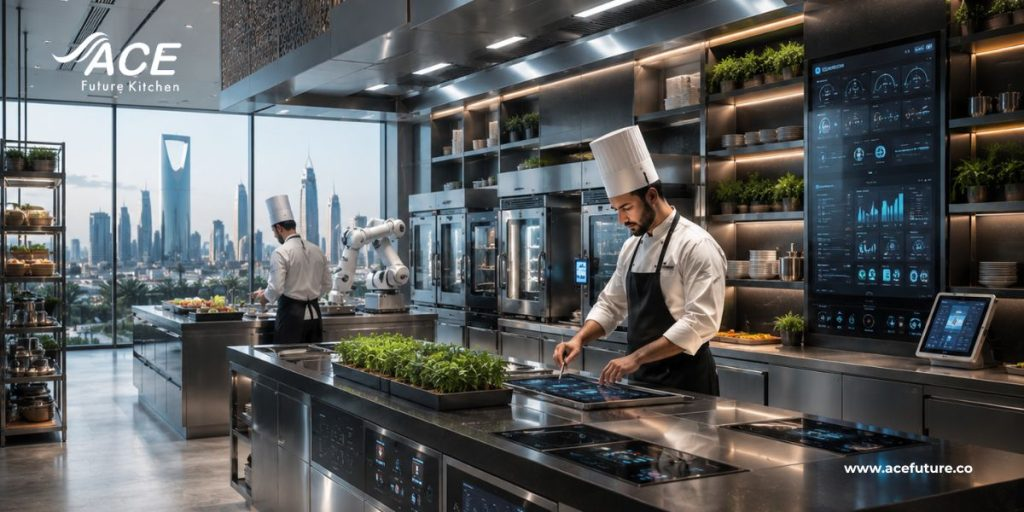
Saudi Arabia’s giga-projects, including NEOM, Red Sea Global, Diriyah, and other major developments, are creating demand for industrial kitchen equipment Saudi Arabia at a significant scale.
These projects involve hotels, restaurants, catering facilities, staff dining operations and other foodservice environments, all of which require professionally specified commercial kitchens.
The equipment requirements for these projects are complex.
Long lead times, technical specifications from international consultants, coordination with MEP contractors, project schedules, quality control and commissioning requirements all need to be considered.
For large projects, selecting equipment is only one part of the process. The contractor must also manage delivery, installation, testing, commissioning and after-sales support.
This is where experienced commercial kitchen contractors in Saudi Arabia play an important role.
Ace Future Kitchen has worked on commercial kitchen projects across the Kingdom, including large hospitality and development projects. Its website highlights more than 25 years of industry experience and projects across hotels, restaurants, healthcare and other sectors.
Businesses planning a major kitchen installation can also review our guide on how to plan a commercial kitchen for a restaurant in Saudi Arabia.
With all these trends moving fast, choosing the right commercial kitchen equipment Saudi Arabia partner matters more than ever.
Here is what operators should look for:
Has the contractor delivered large-scale hospitality or foodservice projects in KSA? Do they understand coordination with main contractors, MEP teams and consultants?
Does the contractor have access to reputable commercial kitchen equipment brands?
A strong brand portfolio allows operators to select equipment according to the application, capacity, budget and operational requirements rather than simply choosing whatever happens to be available.
Supplying equipment is only part of the job.
Proper installation, testing and commissioning are essential to ensure equipment performs as specified from day one.
Equipment imported or supplied for the Saudi market may need to meet applicable technical and conformity requirements.
Before purchasing, businesses should confirm applicable requirements and documentation for their equipment.
Our guide to SABER Commercial Kitchen Equipment Rules 2026 explains important compliance considerations for restaurant and commercial kitchen equipment.
Maintenance and spare-parts availability matter enormously in a commercial kitchen.
Downtime is costly, particularly for restaurants, hotels, hospitals and high-volume catering operations.
A contractor with technical support, maintenance capability and access to spare parts can help protect the long-term value of the equipment investment.
For ongoing support, see our commercial kitchen maintenance services in Saudi Arabia.
The future of commercial kitchens in Saudi Arabia is being shaped by Vision 2030, the growth of the hospitality sector, major tourism and development projects, the rise of cloud kitchens, and advances in kitchen technology.
Smart equipment, energy efficiency, sustainability, automation and better maintenance are becoming increasingly important considerations for operators planning new facilities or upgrading existing kitchens.
For restaurant owners, hotel operators, catering companies and facility managers across the Kingdom, staying informed about commercial kitchen trends Saudi Arabia 2026 can help them make better equipment and operational decisions.
The future of commercial kitchens is not based on one technology or one type of equipment. Instead, it is about bringing together reliable equipment, efficient workflows, smart monitoring, sustainability, compliance and experienced technical support.
Commercial kitchen trends Saudi Arabia 2026 point toward kitchens that are smarter, more efficient, more sustainable and better supported than ever before.
The leading trends include smart commercial kitchens with IoT connectivity, energy-efficient kitchen equipment, sustainable kitchen practices, cloud kitchens, automation and increased use of AI-assisted monitoring for food safety, inventory and equipment performance.
Technology is transforming commercial kitchens through connected equipment, AI-powered inventory and monitoring systems, automated cooking technology, digital production planning and advanced ventilation systems that can improve energy performance and operational control.
The best commercial kitchen equipment depends on the specific operation, menu, production volume, available space and budget.
Restaurants may require cooking ranges, fryers, grills, ovens, refrigeration and preparation equipment, while hotels and large catering facilities may require more extensive cooking, cold storage, warewashing, ventilation and food production systems.
Equipment should also be evaluated for reliability, energy consumption, compliance, installation requirements and after-sales support.
Cloud kitchens require compact, high-output equipment that can handle multiple menus within a limited space.
This has increased demand for versatile cooking equipment, efficient ventilation, reliable refrigeration, compact preparation systems and technology that supports production and order management.
Look for a contractor with proven experience on commercial kitchen projects in KSA, access to reputable equipment brands, installation and commissioning capabilities, compliance knowledge and a strong after-sales service department.
Before committing, ask about previous projects, warranty coverage, spare-parts availability, maintenance support and the full scope of installation.
Smart technology can be useful for businesses that need better equipment monitoring, energy management, temperature tracking, inventory control and operational visibility.
The right technology depends on the size and requirements of the kitchen. Operators should consider integration, maintenance, staff training and long-term support before investing.
Commercial kitchens operate equipment for long hours, including cooking equipment, refrigeration, dishwashers and ventilation systems.
Energy-efficient equipment can help reduce operating costs over time while supporting more sustainable kitchen operations.
Consider your menu, expected production volume, available kitchen space, equipment capacity, energy consumption, compliance requirements, installation needs, maintenance requirements and after-sales support.
A detailed equipment plan can help prevent unnecessary purchases and reduce the risk of equipment being unsuitable for the operation.
Saudi Arabia’s commercial foodservice industry is entering a period where technology, efficiency and operational reliability matter more than ever.
For restaurant owners, hotel operators, catering companies and large-scale project developers, the right commercial kitchen is not simply a collection of machines. It is an integrated system designed around workflow, food safety, energy efficiency, technology, sustainability and long-term performance.
Businesses planning a new commercial kitchen or upgrading an existing facility should evaluate current trends while also considering their own menu, production requirements and future growth.
For a complete overview of commercial kitchen solutions available across Saudi Arabia, explore Ace Future Kitchen’s commercial kitchen solutions and speak with a specialist about your project requirements.

With 38 years of experience in the industrial kitchen and laundry business, our Co-founder began his career as a Sales Manager in 1986 and later became the CEO of a major kitchen and laundry contractor in KSA in 1999.
Top 3 Commercial Kitchen Equipment Supplier in Saudi Arabia for Restaurant Owners
July 30, 2026
Top 5 Commercial Kitchen Equipment Supplier in Saudi Arabia (2026 Comparison)
July 27, 2026
Top 3 Kitchen and Laundry Equipment Contractor in Saudi Arabia: What to Check Before You Sign
July 17, 2026