
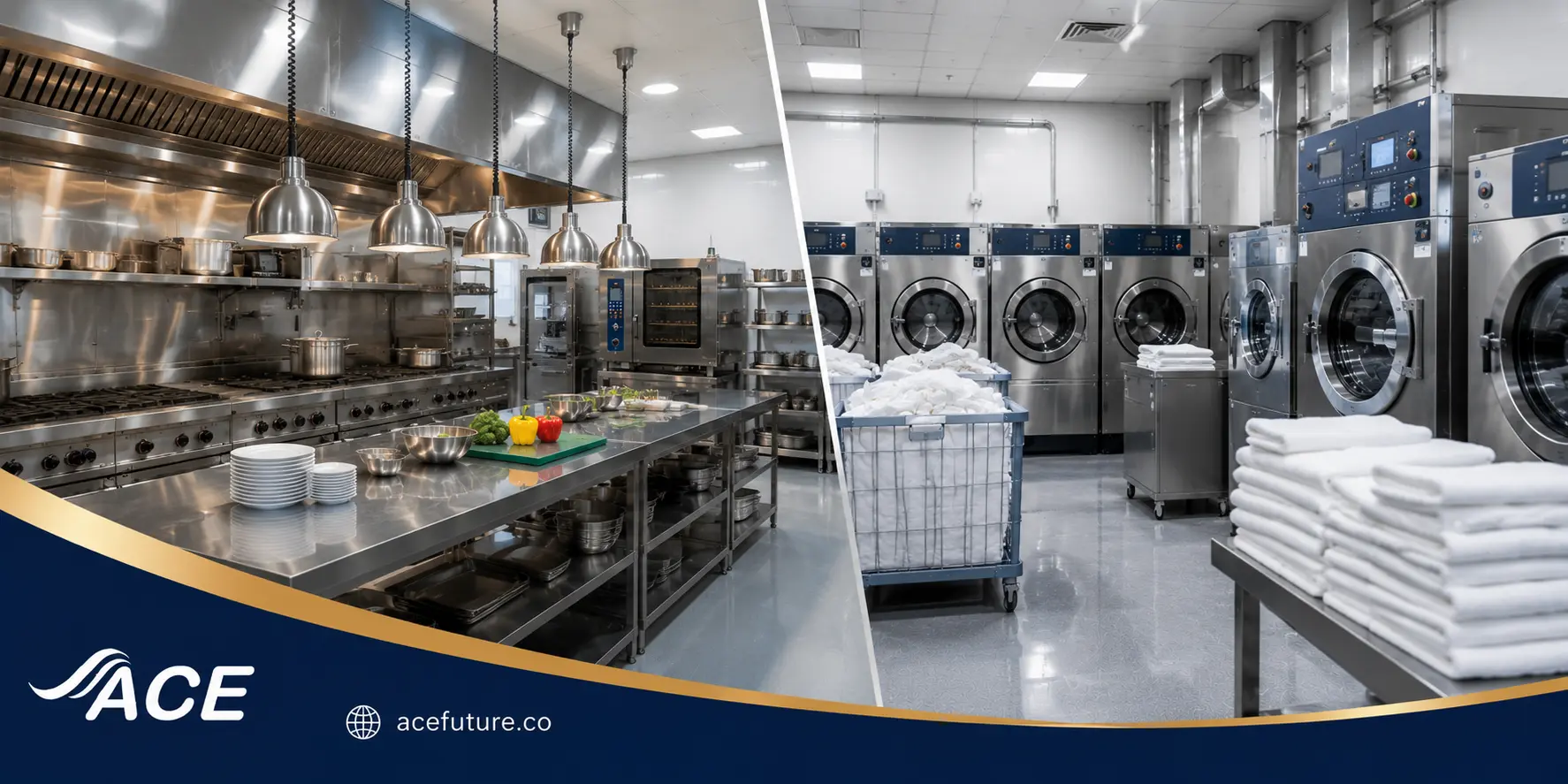
Choosing the right kitchen and laundry equipment contractor in Saudi Arabia is about much more than comparing equipment prices.
A commercial kitchen, hotel laundry, bakery, hospital kitchen, or foodservice facility depends on equipment being correctly selected, supplied, installed, tested, commissioned, and supported after handover. If the contractor’s scope is unclear at the beginning, problems can appear later through installation delays, missing compliance documents, unclear warranties, spare-parts issues, or unexpected maintenance costs.
At Ace Future Kitchen, we have seen projects that ran smoothly because the contractor scope was checked carefully before the contract was signed, as well as projects where additional work was needed because important details were not clarified at the beginning.
This guide explains what to check before hiring a kitchen and laundry equipment contractor in Saudi Arabia, how to compare contractors, and what questions to ask before committing to a project.
Most commercial kitchen and laundry projects involve more than simply purchasing equipment.
A typical project can include:
The important question is therefore not only:
“How much does the equipment cost?”
It is:
“What exactly will the contractor deliver, install, commission, and support for the quoted price?”
A lower equipment price can become more expensive if installation, testing, commissioning, spare parts, or after-sales support are excluded.
One of the first things to establish is whether you are dealing with an equipment supplier or a full-scope contractor.
A supplier may primarily provide and deliver equipment. A contractor may take responsibility for a wider part of the project, including installation, testing, commissioning, coordination, and after-sales support.
| Project Requirement | Equipment Supplier | Full-Scope Contractor |
| Equipment supply | Usually | Yes |
| Equipment selection | Depending on supplier | Yes |
| Delivery | Usually | Yes |
| Installation | May be optional | Usually included |
| Testing | May be limited | Yes |
| Commissioning | May be limited | Yes |
| Site coordination | Limited or project-dependent | Usually included |
| MEP coordination | Project-dependent | Should be clearly defined |
| Warranty support | Usually | Yes |
| Spare parts | Depends on brand | Should be confirmed |
| Maintenance / AMC | Depends on supplier | Should be available or clearly defined |
| Project handover | Limited | Should be included in full-scope projects |
Before signing, ask the contractor to clearly identify which of these responsibilities are included in the quotation.
Ask how long the contractor has been operating in Saudi Arabia and, more importantly, whether they have completed projects similar to yours.
A contractor experienced with a small restaurant may not have the same project experience required for:
Ask for references from at least two projects that are similar in size, equipment type, or operational requirements.
Useful questions include:
Past project experience gives you more useful information than a contractor’s marketing claims alone.
Do not rely only on a contractor saying that equipment is compliant.
Ask for the applicable compliance documentation for the specific equipment and shipment.
Depending on the equipment and applicable Saudi requirements, this may include:
The important point is to verify what applies to the actual equipment being ordered rather than accepting a generic statement that everything is “SASO compliant.”
Ask the contractor:
“Can you provide the compliance documentation for the exact models included in my quotation?”
If documentation is unclear, ask for clarification before placing the order.
One of the most important questions to ask a commercial kitchen equipment contractor is:
“Does your quotation include installation?”
Do not assume that equipment supply automatically includes complete installation.
Confirm whether the quotation includes:
Also clarify which site works remain the client’s responsibility.
For example, determine who is responsible for:
The more clearly these responsibilities are defined before installation, the less likely you are to face scope disputes later.
Installation is not necessarily the end of the contractor’s responsibility.
Commercial kitchen and laundry equipment should be properly tested and commissioned before the facility is handed over.
Ask:
For a larger project, ask for a commissioning and handover process in writing.
This is particularly important for equipment that needs correct utility connections, operating procedures, temperature settings, safety checks, or programmed operating cycles.
Warranty terms can vary significantly between equipment brands, suppliers, and contractors.
Do not accept a general statement such as “one-year warranty” without asking what that warranty actually covers.
Confirm:
Also ask what happens after the warranty expires.
A contractor that can support the equipment after handover can be more useful than one that only handles the initial supply.
Equipment downtime can affect restaurant operations, hotel services, hospital foodservice, laundry operations, and other commercial facilities.
Ask the contractor:
You should also ask whether replacement parts are original manufacturer parts or compatible alternatives.
For critical equipment, identify important spare parts before the project is completed.
A commercial kitchen or laundry does not stop needing support after installation.
Ask whether the contractor provides:
If an AMC is available, ask for the actual service scope rather than simply asking whether the contractor “offers AMC.”
Important points include:
Maintenance terms should be clear before the equipment is handed over.
When comparing three contractor quotations, place the proposals side by side.
If you are researching the Saudi Arabian commercial kitchen and laundry equipment market, three names worth investigating are Ace Future Kitchen, Al-Mohtaseb, and FESCO.
The right choice for a project depends on the equipment requirements, technical scope, installation responsibilities, compliance requirements, project size, location, warranty, and after-sales service.
Ace Future Kitchen has operated since 2000 and provides commercial kitchen, laundry, and bakery equipment solutions in Saudi Arabia.
Its project scope includes equipment supply, installation, testing, and commissioning, with maintenance and AMC support available after project handover.
For projects requiring more than equipment supply, ask the contractor to confirm the complete project scope, including installation, commissioning, warranty, spare parts, and maintenance.
Al-Mohtaseb is another established name associated with stainless steel central kitchen and laundry equipment in Saudi Arabia.
When evaluating the company for a specific project, confirm the exact scope being offered, including equipment supply, installation, commissioning, warranty, spare parts, and maintenance.
FESCO is another company to include when researching foodservice and laundry equipment suppliers and contractors for commercial projects.
As with any contractor or supplier, compare its actual quotation and project scope against other proposals rather than comparing company names alone.
| Contractor | Kitchen Equipment | Laundry Equipment | Installation | Testing & Commissioning | Maintenance / AMC |
| Ace Future Kitchen | Yes | Yes | Yes | Yes | Yes |
| Al-Mohtaseb | Yes | Yes | Confirm by project | Confirm by project | Confirm by project |
| FESCO | Yes | Yes | Confirm by project | Confirm by project | Confirm by project |
The purpose of this comparison is to identify what must be verified in each quotation. Project scope can differ depending on the equipment, client requirements, location, and contract.
If you are currently collecting quotations, use this process.
Start with contractors that have experience with projects similar to yours.
Give each contractor the same equipment list, layout information, specifications, and project requirements.
This makes the quotations easier to compare.
Ask for the applicable documentation for the specific equipment before finalising the purchase.
Do not compare only the equipment price.
Compare:
Give every contractor the same questions so you can compare their responses consistently.
Review the scope, payment terms, delivery timeline, warranty, replacement policy, and maintenance terms before signing.
Ask what happens when the equipment needs servicing after the project is completed.
A complete commercial kitchen project can involve much more than individual equipment purchases.
Depending on the project, the scope may include:
Before accepting a quotation, ask the contractor to identify exactly which items are included and which remain the client’s responsibility.
Project requirements can differ between Riyadh, Jeddah, Dammam, Khobar, and other locations across the Kingdom.
When selecting a contractor, confirm:
For projects outside major cities, also ask about technician travel time and emergency service arrangements.
Kitchen and laundry projects are often connected to other operational requirements.
A restaurant may require cooking and refrigeration equipment. A bakery may need mixers, ovens, proofers, preparation equipment, and cooling systems. A hotel may require both kitchen and laundry equipment. A larger foodservice operation may also require cold rooms and freezer rooms.
For this reason, it can be useful to evaluate whether your contractor can support multiple parts of the project rather than coordinating several unrelated suppliers.
Ace Future Kitchen provides commercial kitchen, laundry, bakery, and related equipment solutions as part of its project offering.
At Ace Future Kitchen, our process is built around the areas clients should clarify before signing a commercial kitchen or laundry equipment contract.
Our approach includes:
If you are comparing contractors, you can use the checklist in this guide when discussing your project with us.
The objective should be simple: understand exactly what you are buying, who is responsible for each part of the project, and what support you will receive after installation.
Before signing your kitchen and laundry equipment contract, confirm all of the following:
If all of these points are clear, you have a much better basis for comparing contractors and understanding the real cost of the project.
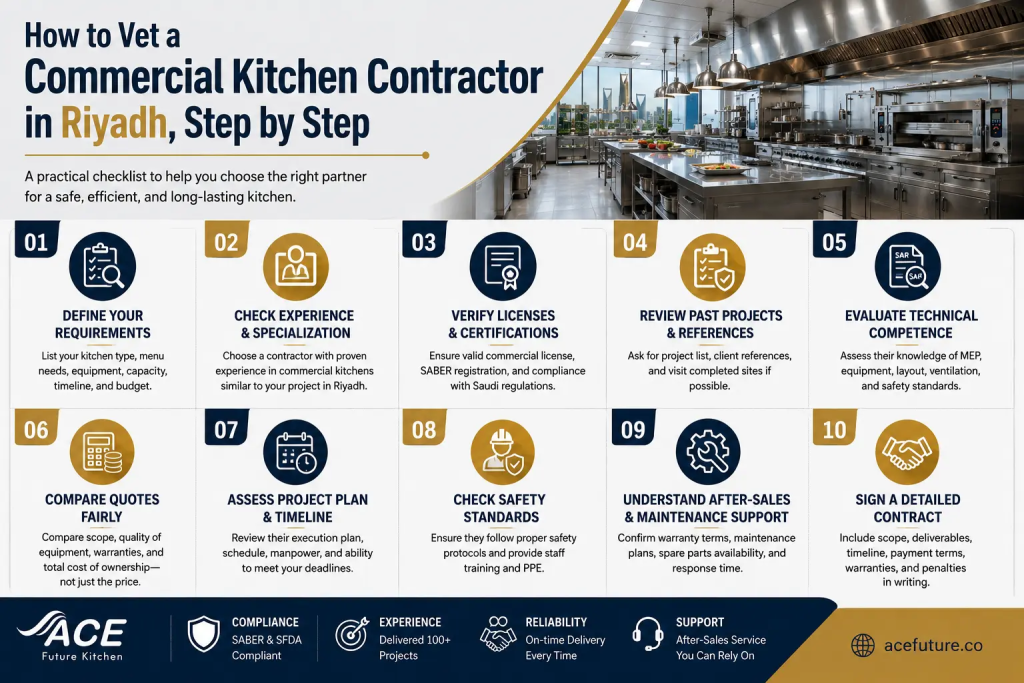
If you want a simple process to follow, use this order.
We walk through the difference between a full-scope contractor and a basic supplier in our guide on commercial kitchen equipment for restaurants in Saudi Arabia, which is worth reading alongside this checklist.
We built our process around the exact points owners tend to miss when they are in a hurry to open.
If you are comparing contractors right now, you are welcome to bring your questions to us directly through our contact us page, and we will answer them the same way we have laid them out here.
The best time to catch a bad contractor is before you sign, not after equipment is already installed. A short list of questions and a careful read of the contract terms will tell you almost everything you need to know. We would rather a client walk away with the right information than sign quickly and regret it later, whether that client chooses us or someone else on this list.

Check the contractor’s relevant Saudi Arabia experience, equipment specifications, applicable compliance documentation, installation scope, testing and commissioning responsibilities, warranty, spare-parts availability, maintenance support, payment terms, and project references.
Common warning signs include vague compliance information, unclear installation responsibilities, undocumented warranty promises, no relevant project references, unclear after-sales support, and quotations that do not clearly explain what is included.
A supplier may primarily provide and deliver equipment, while a full-scope contractor may also manage installation, testing, commissioning, coordination, handover, and after-sales support. Always confirm the exact scope in writing because responsibilities vary between companies and projects.
If you require the contractor to install the equipment, installation should be explicitly included in the quotation or contract. Also confirm whether testing, commissioning, utility connections, MEP coordination, training, and handover are included.
Warranty periods vary by equipment type, manufacturer, contractor, and contract. Ask for the exact warranty duration and confirm whether it covers parts, labour, service calls, and other costs.
An AMC can provide structured preventive and corrective maintenance, but the appropriate arrangement depends on the equipment, facility, operating hours, and project requirements. Ask the contractor what is included in its AMC and what is excluded.
Ask the contractor which Saudi requirements apply to the specific equipment and request the relevant documentation for the exact models being purchased. Where applicable, this may include Product Certificates of Conformity, Shipment Certificates of Conformity, and supporting test documentation.
Do not compare quotations on equipment price alone. Compare the complete scope, including equipment specifications, delivery, installation, testing, commissioning, warranty, spare parts, maintenance, training, and handover.
For many commercial projects, comparing two or three contractors can provide a useful basis for understanding differences in equipment, scope, pricing, and service. Make sure each contractor receives the same project requirements so the quotations are comparable.
Ask which spare parts are normally stocked, how non-stock parts are sourced, expected lead times, whether original manufacturer parts are supplied, and who handles technical identification and replacement.
Check Saudi project experience, similar project references, equipment specifications, installation capability, testing and commissioning, applicable compliance requirements, warranty, spare parts, AMC, and response times for maintenance or breakdowns.
Some contractors provide multiple equipment categories under one project scope, while others specialise in particular areas. Confirm the exact equipment categories, installation responsibilities, and after-sales support included in your project.
The best time to identify gaps in a kitchen and laundry equipment project is before the contract is signed.
Do not compare contractors only by equipment price or company name. Compare their experience, technical scope, compliance documentation, installation capability, testing and commissioning process, warranty, spare-parts support, maintenance options, and project references.
A clear contract protects both the client and the contractor by making responsibilities easier to understand from the beginning.
Whether you are planning a restaurant, hotel, hospital, bakery, central kitchen, commercial laundry, or another foodservice facility in Saudi Arabia, use this checklist before committing to your equipment contractor.

With 38 years of experience in the industrial kitchen and laundry business, our Co-founder began his career as a Sales Manager in 1986 and later became the CEO of a major kitchen and laundry contractor in KSA in 1999.
Top 3 Commercial Kitchen Equipment Supplier in Saudi Arabia for Restaurant Owners
July 30, 2026
Top 5 Commercial Kitchen Equipment Supplier in Saudi Arabia (2026 Comparison)
July 27, 2026
Top 3 Kitchen and Laundry Equipment Contractor in Saudi Arabia: What to Check Before You Sign
July 17, 2026