
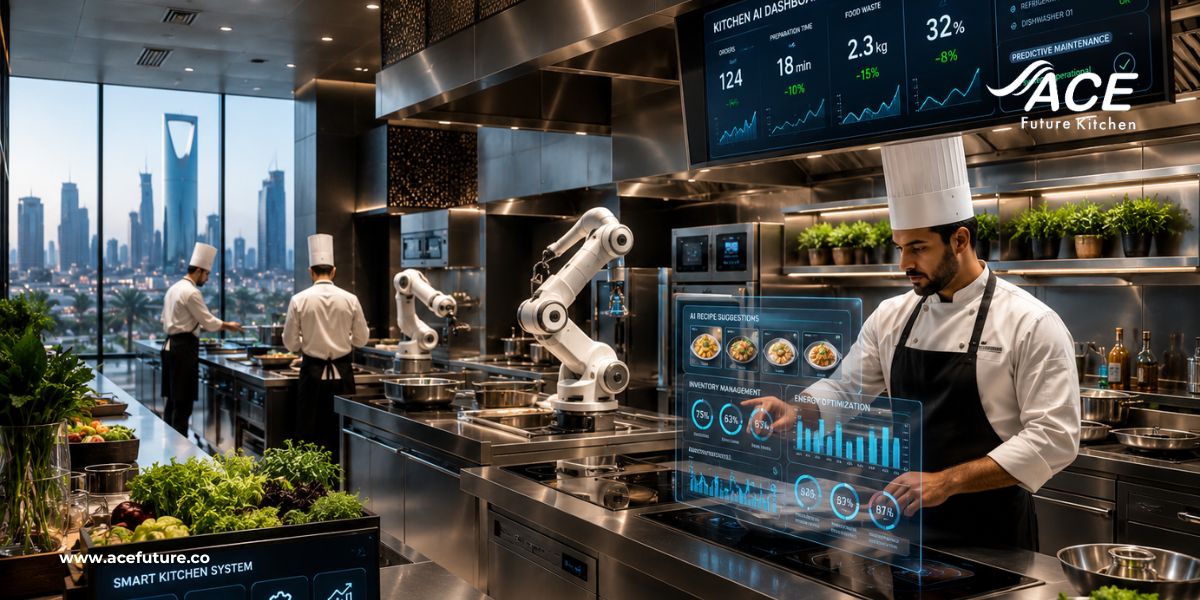
The food and hospitality industry in Saudi Arabia is going through a major transformation. New hotels, restaurants, cloud kitchens, and large catering operations are opening across the Kingdom at a rapid pace. Behind the scenes, in every one of these kitchens, technology is playing a bigger role than ever before.
AI in commercial kitchens Saudi Arabia is no longer a topic reserved for technology conferences. It is a practical, real-world shift that is already affecting how kitchens are run, how equipment is managed, and how food is prepared and served at scale.
In this article, we look at how artificial intelligence in commercial kitchens is changing daily operations, what the real benefits are for restaurant and hotel operators, and what Saudi Arabia’s food service industry can expect as this technology continues to develop through 2026 and beyond.
Before going further, it helps to be clear about what AI in commercial kitchens Saudi Arabia actually means in practice because there is a lot of confusion around this topic.
Artificial intelligence in a kitchen context does not mean robots replacing chefs. It means software and connected equipment working together to collect data, identify patterns, make predictions, and automate certain tasks that would otherwise require human time and attention.
This can include a refrigeration unit that monitors its own temperature and sends an alert when something is wrong. It can include an inventory system that tracks ingredient usage and predicts when stock needs to be reordered. It can include a ventilation system that adjusts its output automatically based on what is being cooked at any given moment.
These are all real, available applications of artificial intelligence in commercial kitchens that operators in Saudi Arabia are beginning to adopt and the pace of adoption is accelerating.
| Application | What it does | Main benefit |
|---|---|---|
| Predictive maintenance | Detects early signs of equipment wear | Less downtime and fewer emergency repairs |
| Inventory management | Forecasts stock needs from usage patterns | Lower food cost and less waste |
| Energy management | Adjusts ventilation and refrigeration to real activity | Lower energy bills |
| Kitchen management software | Plans production and logs compliance data | Less admin and more consistency |
| Temperature monitoring | Tracks cold rooms and hot holding automatically | Better food safety records |
Each of these is explained in more detail below.
One of the most immediately valuable applications of AI in commercial kitchens Saudi Arabia is predictive maintenance. This is where intelligent kitchen equipment uses sensors and data analysis to detect early signs of wear or malfunction before they become serious problems.
In a busy kitchen, whether in a hotel in Riyadh, a restaurant at KAFD, or a catering facility serving thousands of meals a day, equipment failure is expensive. It causes delays, puts food safety at risk, and creates significant stress for kitchen teams. In the worst cases, it forces a kitchen to partially or fully shut down during service.
Predictive maintenance powered by AI changes this situation significantly. Instead of waiting for a problem to appear, the system identifies warning signs early. The kitchen manager or equipment contractor receives an alert. The issue is addressed before it becomes a breakdown.
For smart commercial kitchen equipment that runs for long hours under heavy use combi ovens, blast chillers, dishwashers, and refrigeration systems this kind of monitoring is enormously valuable. It extends equipment life, reduces emergency repair costs, and keeps kitchens running smoothly.
Brands like RATIONAL, Meiko, and Winterhalter available through specialist contractors like Ace Future Kitchen already offer connected equipment with remote monitoring capabilities that feed into this kind of predictive maintenance approach.
Want to know which smart and IoT-ready equipment is most relevant for KSA operators right now? Read this: Smart Kitchen Technology: The IoT Equipment Every KSA Operator Needs in 2026 (add URL)
Food waste is one of the biggest operational challenges facing the food service industry globally and Saudi Arabia is no exception. How AI helps with inventory and waste reduction is a question that more and more operators are asking, and the answers are genuinely compelling.
AI for food service industry inventory management works by connecting purchasing records, recipe data, and real-time stock levels into a single system. The AI analyses patterns in ingredient usage accounting for seasonal demand, day-of-week variations, and upcoming bookings and generates accurate purchasing recommendations.
The result is that kitchens order closer to what they actually need. Less food sits in storage for too long. Less food is thrown away. The financial savings is real and measurable.
For large operations hotel banqueting kitchens, hospital catering, staff dining for large workforces this kind of AI-assisted inventory management can make a substantial difference to the monthly food cost. For smaller restaurant operators, it simplifies a task that often gets neglected in the pressure of daily service.
Commercial kitchen automation through AI-assisted inventory systems is one of the clearest examples of how this technology pays for itself relatively quickly through direct cost savings.
Energy consumption is a significant operating cost for any commercial kitchen. Equipment runs for long hours, ventilation systems move large volumes of air, and refrigeration runs continuously around the clock. Smart kitchen technology Saudi Arabia operators are increasingly adopting includes AI-driven energy management systems that reduce this consumption meaningfully.
How does this work in practice? Intelligent kitchen equipment and connected ventilation systems can monitor actual cooking activity and adjust their output accordingly. Instead of running at full power all the time, a ventilation hood reduces its fan speed during quieter periods and increases it automatically when cooking activity rises. This alone can reduce ventilation energy consumption significantly.
Connected refrigeration systems can optimize their compressor cycles based on actual usage patterns, reducing energy draw during periods when doors are opened less frequently.
Smart commercial kitchen equipment with AI-driven energy management is particularly relevant in Saudi Arabia given the scale of hospitality operations being developed here. For giga-projects like NEOM, Red Sea Global, and Diriyah where dozens of kitchens may be operating under the same management structure the cumulative energy savings from smart systems are very significant.
This aligns directly with Saudi Vision 2030’s sustainability goals and is one reason why AI-powered kitchen technology is being specified more frequently on large projects across the Kingdom.
Explore the full range of commercial kitchen equipment available for Saudi operators: Commercial Kitchen in Saudi Arabia
Beyond equipment-level AI, kitchen management software is transforming how commercial kitchens are organised and run. This category covers a wide range of tools from digital production planning systems that help kitchen teams prepare the right quantities at the right time, to temperature monitoring platforms that automatically log food safety compliance data.
For restaurant technology trends Saudi Arabia operators are watching closely, kitchen management software sits near the top of the list. The reason is simple: it reduces the administrative burden on kitchen managers, improves consistency, and creates a digital record of operations that is increasingly required for food safety compliance.
AI for food service industry management platforms can analyse sales data from a restaurant’s point-of-sale system and automatically adjust production targets for the kitchen. If Tuesday lunches are consistently quieter than Wednesday lunches, the system accounts for this without requiring a manager to manually review the numbers each week.
This kind of commercial kitchen automation not replacing people, but removing repetitive and time-consuming tasks from their workload is where AI delivers very practical value in day-to-day kitchen operations.
Food safety is non-negotiable in any commercial kitchen. In Saudi Arabia, where large hospitality operations serve thousands of guests daily, maintaining strict food safety standards across every station, every shift, and every service period is a serious operational challenge.
Artificial intelligence in commercial kitchens is making food safety management significantly more reliable. AI-connected temperature monitoring systems continuously log temperatures across cold rooms, display cabinets, and hot holding equipment creating an automatic digital record that removes the risk of missed manual checks.
Some systems go further, using AI to identify unusual patterns for example, a cold room that is gradually trending warmer over several days and alerting management before temperatures reach a critical threshold. This kind of early warning is far more reliable than manual checking, which is subject to human error and time gaps between checks.
For large hotel kitchens, hospital catering, and any operation serving vulnerable groups, this application of AI in commercial kitchens Saudi Arabia is particularly important. It reduces risk, simplifies compliance, and provides clear documentation if questions are ever raised about food safety standards.
Saudi Arabia’s heat makes refrigeration one of the hardest-working systems in any kitchen, and one of the costliest to lose. A failed cold room can mean a full stock write-off in a single night. Smart monitoring helps by:
A well-installed cold room with remote monitoring gives operators confidence even when the kitchen is closed overnight.
Cloud kitchens are one of the fastest-growing segments of the Saudi food industry. Operating without a dining room and focused entirely on delivery, cloud kitchens depend on efficiency, speed, and consistency more than almost any other type of food operation.
AI-powered kitchen technology fits naturally into the cloud kitchen model. Automated ordering systems, AI-assisted production planning, and smart equipment monitoring all help cloud kitchen operators run leaner and faster. With multiple brands often operating from the same kitchen space, the ability to track performance, manage inventory, and monitor equipment across multiple concepts simultaneously is a real operational advantage.
Restaurant technology trends Saudi Arabia are increasingly being shaped by what cloud kitchen operators require and as this segment grows, the demand for smart kitchen technology Saudi Arabia suppliers can reliably deliver will only increase.
Understanding the role of AI in kitchen operations has practical implications for the equipment choices operators make. Not all equipment is created equal when it comes to connectivity and smart capability.
When specifying smart commercial kitchen equipment, operators and their contractors should consider whether equipment offers remote monitoring capability, whether it can integrate with existing building management or kitchen management systems, what data it collects and how accessible that data is, and what the manufacturer’s support structure looks like for connected equipment in Saudi Arabia.
Choosing equipment from leading global brands with established connectivity features and working with a contractor who understands how to integrate these systems properly is what separates a genuinely smart kitchen from one that simply has expensive equipment installed without the supporting infrastructure to make it perform.
Avoid costly mistakes when choosing and installing kitchen equipment: 5 Kitchen Equipment Mistakes New Saudi Restaurant Owners Make (add URL)
It is worth being clear about something important: AI in commercial kitchens Saudi Arabia does not reduce the importance of skilled people. It supports them.
Experienced kitchen equipment contractors who understand how to properly install, commission, and maintain connected equipment are more important than ever. The technology only delivers its promised benefits when the underlying equipment is correctly installed, properly set up, and regularly maintained by people who know what they are doing.
For operators investing in intelligent kitchen equipment and smart kitchen systems, choosing the right equipment contractor, one with proven experience, a strong technical team, and reliable after-sales support is just as important as choosing the right equipment brands.
See how kitchen layout choices affect equipment performance and team workflow: Open Kitchen vs. Closed Kitchen: What Works Best for Saudi Restaurants? (add URL)
You do not need to automate everything at once. A practical path looks like this:
If you are planning a new kitchen, it is far easier to specify connected equipment from the start than to retrofit it later. Our team can advise through our turnkey kitchen solutions.
The future of AI in Saudi Arabia’s food service industry is one of continued and accelerating growth. As Vision 2030 drives expansion across hospitality, tourism, and entertainment and as Saudi consumers continue to embrace food delivery and new dining formats the pressure on commercial kitchens to perform at a higher level will only increase.
AI in commercial kitchens Saudi Arabia will become a standard expectation rather than a premium feature. Operators who begin adopting smart kitchen technology now will be better positioned as these expectations rise. Those who delay will find themselves catching up at higher cost and with less competitive advantage.
The most successful kitchen operations in Saudi Arabia over the next five years will be those that combine world-class equipment, smart technology, and experienced human expertise working together as an integrated system.
AI is being used in Saudi commercial kitchens for predictive equipment maintenance, automated temperature monitoring for food safety compliance, AI-assisted inventory management to reduce waste, energy management systems that adjust equipment output based on cooking activity, and kitchen management software that improves production planning and operational efficiency.
The main benefits include reduced equipment downtime through predictive maintenance, lower food costs through smarter inventory management, improved food safety through automated monitoring, reduced energy consumption through intelligent equipment control, and less administrative burden on kitchen management teams.
No. AI in commercial kitchens supports kitchen staff rather than replacing them. It removes repetitive and time-consuming tasks like manual temperature logging or stock counting freeing up kitchen teams to focus on food preparation and service. Skilled technicians and kitchen professionals remain essential.
Yes. Leading global equipment brands with smart and AI-connected features are available in Saudi Arabia through specialist kitchen equipment contractors. When choosing a contractor, operators should confirm that the contractor has experience with connected equipment installation and can provide reliable after-sales support for smart systems within the Kingdom.
The best starting point is to work with an experienced commercial kitchen equipment contractor who understands both the equipment options and how they integrate in a real kitchen environment. Identify the areas of your operation where AI will deliver the most immediate value whether that is food safety monitoring, inventory management, or equipment reliability and build from there.
Predictive maintenance uses sensor data to spot early signs of equipment problems, such as a compressor drawing more power than normal, so repairs can be scheduled before a breakdown happens. It works best alongside regular preventive servicing.
Not always. Some operators add sensors or monitoring platforms to existing refrigeration and cooking equipment, while new projects can specify connected equipment from the start. An experienced contractor can advise on which approach suits your kitchen. You can also browse our commercial kitchen FAQ for Saudi Arabia.
Connected equipment still needs skilled technicians for installation, commissioning, servicing and repairs. Look for a contractor that offers all of these under one roof, so that alerts from your monitoring system lead to quick action.
Ready to plan a smarter commercial kitchen? Contact Ace Future Kitchen for a free consultation.

With 38 years of experience in the industrial kitchen and laundry business, our Co-founder began his career as a Sales Manager in 1986 and later became the CEO of a major kitchen and laundry contractor in KSA in 1999.
Top 3 Commercial Kitchen Equipment Supplier in Saudi Arabia for Restaurant Owners
July 30, 2026
Top 5 Commercial Kitchen Equipment Supplier in Saudi Arabia (2026 Comparison)
July 27, 2026
Top 3 Kitchen and Laundry Equipment Contractor in Saudi Arabia: What to Check Before You Sign
July 17, 2026