
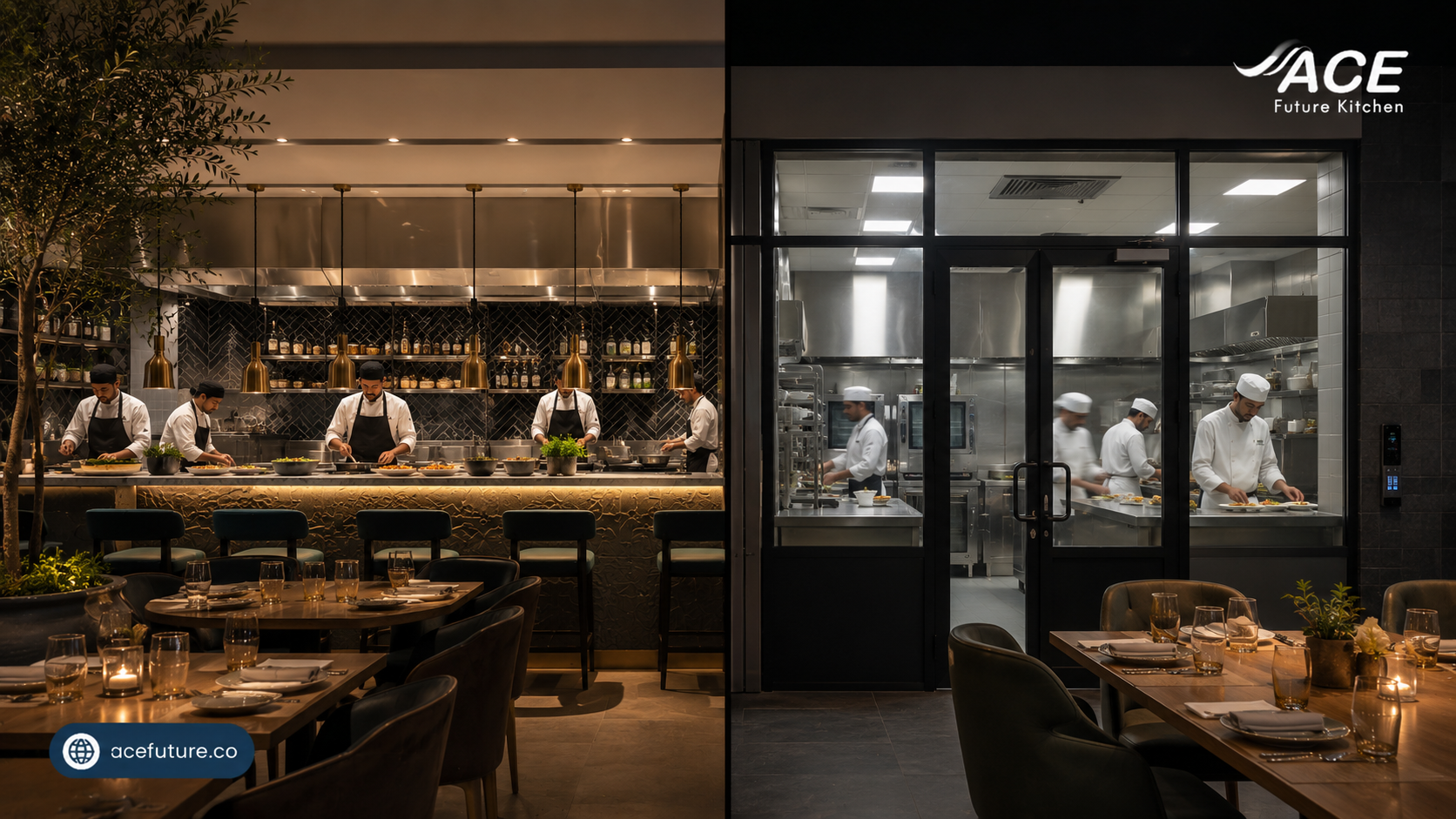
When setting up a restaurant in Saudi Arabia, one of the earliest and most impactful decisions you will face is whether to go with an open kitchen or a closed kitchen.
This decision affects more than just the look of your restaurant. It shapes your customer experience, your ventilation requirements, your staff workflow, your compliance with SFDA standards, and the type of equipment you need.
At Ace Future Kitchen, we work with restaurant owners, hotel operators, and catering businesses across KSA. We help them understand what each kitchen setup requires and which one genuinely suits their concept, their menu, and their operation.
This guide gives you a clear and honest comparison so you can make the right call for your business.
Before comparing the two, it is important to understand what each one actually means in a restaurant context.
An open kitchen is a kitchen that is fully or partially visible to restaurant guests. There is no wall separating the cooking area from the dining area. Guests can see the chefs at work, watch food being prepared, and observe the kitchen environment in real time.
Open kitchens are common in:
A closed kitchen is a kitchen that is completely separated from the dining area by walls, doors, or partitions. Guests do not see the kitchen at any point during their visit. All food preparation happens behind closed doors and is only seen when it reaches the table.
Closed kitchens are common in:
| Feature | Open Kitchen | Closed Kitchen |
| Guest Visibility | Full or partial | None |
| Customer Experience | Immersive and interactive | Traditional and private |
| Ventilation Requirement | Very high | Standard commercial |
| Noise Impact on Dining | Higher | Minimal |
| Staff Pressure | High always visible | Lower |
| Menu Flexibility | Limited to clean, visual cooking | Unlimited |
| SFDA Compliance Complexity | Higher | More straightforward |
| Space Requirement | Larger (combined with dining) | More efficient separation |
| Best For | Concept dining, fine dining | High-volume, traditional dining |
| Equipment Visibility | Must be clean and presentable | Functional priority only |
The open kitchen concept has grown significantly in Saudi Arabia over the past few years, particularly in Riyadh, Jeddah, and AlUla driven by the growth of dining culture under Vision 2030 and the rise of premium restaurant concepts.
An open kitchen works well for Saudi restaurants when:
An open kitchen may not be the right fit when:
There is no single right answer. The best kitchen setup for a Saudi restaurant depends on your specific concept, your location, your customer profile, and your operational model.
When guests can see their food being prepared, it creates immediate confidence in hygiene and quality. In a market where food safety awareness among Saudi consumers is growing rapidly, this visibility is a genuine commercial advantage.
An open kitchen turns the cooking process into part of the restaurant’s atmosphere. Live fire grills, fresh pasta being made, or sushi being crafted at a counter these moments elevate a meal from food to experience. This is increasingly what premium restaurant customers in KSA are looking for.
For restaurants built around a culinary identity a specific cuisine, a chef’s personal style, or a farm-to-table concept an open kitchen gives the brand a visual language that goes beyond the menu. It shows rather than tells.
When the kitchen is visible, standards stay high. Cleanliness, organisation, and professional behaviour are constant in an open kitchen because the team knows they are always in view. This often results in a better-run kitchen overall.
In a competitive dining market like Riyadh or Jeddah, an open kitchen concept is a differentiator. It signals confidence, quality, and a willingness to be accountable to the guest.
Yes for high-volume operations, a closed kitchen is almost always the more practical choice.
Here is why:
In a high-volume restaurant, whether a large family dining outlet, a hotel restaurant, or a quick-service concept, the kitchen must process a very high number of covers quickly. A closed kitchen allows the team to focus entirely on speed and output without managing the additional layer of guest perception.
A closed kitchen imposes no restrictions on your menu. You can use heavy smoke, strong spices, deep fryers, large stockpots, and complex multi-station cooking without any concern about how it looks or smells from the dining area.
Commercial kitchens are loud environments; extraction fans, equipment motors, clattering pans, and team communication all create significant noise. A closed kitchen keeps this entirely out of the dining experience, which matters greatly in formal or family dining settings.
From an SFDA compliance and municipality inspection perspective, a closed kitchen is generally easier to manage. The clear separation between kitchen and dining zones makes zoning, hygiene management, and inspection reporting more straightforward.
Not every kitchen team performs well under constant public observation. In a closed kitchen, chefs can focus fully on the food without the additional pressure of being watched by guests throughout service.
This is one of the most important questions for any restaurant operator in KSA and the answer is yes, it does.
The Saudi Food and Drug Authority (SFDA) and local municipality authorities set clear requirements for commercial kitchen hygiene, zoning, and ventilation. When a kitchen is open to the dining area, these requirements become more complex to meet.
Ventilation and extraction: An open kitchen must have a ventilation and extraction system powerful enough to prevent cooking odours, heat, and smoke from entering the dining area. This typically requires a higher-capacity hood and extraction setup than a standard closed kitchen.
Zoning and cross-contamination prevention: SFDA guidelines require clear separation between raw food handling areas, cooking zones, and service areas. In an open kitchen, these zones must be carefully planned and clearly defined even without physical walls separating them.
Surface and equipment standards: Because the kitchen is visible to guests, all surfaces, equipment, and fittings must meet both hygiene standards and presentational standards. Stainless steel finishes, clean sightlines, and organised storage become both a compliance and a brand requirement.
Waste and dirty zone management: Dish return, waste bins, and washing areas must be positioned so they are not visible from the dining area, even in an open kitchen concept. This requires careful thought about the kitchen’s internal flow.
At Ace Future Kitchen, we guide our clients through these compliance requirements as part of every project. Our work is structured and documented we provide a detailed work report sheet and tracker throughout the project so nothing is missed and every compliance point is addressed on schedule.
The right answer depends on your specific restaurant concept. Here is a practical guide:
Many successful Saudi restaurants use a hybrid kitchen setup: a closed main production kitchen combined with a small open station visible to guests. For example:
This hybrid approach gives you the customer experience benefits of an open kitchen without the full operational complexity.
Whether you are planning an open kitchen concept for a premium dining experience or a high-efficiency closed kitchen for a high-volume operation, the quality of your equipment, installation, and ongoing support will determine how well your kitchen performs day after day, service after service.
At Ace Future Kitchen, we are a trusted restaurant equipment supplier KSA businesses rely on for commercial kitchen projects of all types and sizes. We supply the right equipment, install it to the right standard, and stay available after project completion.
Contact our team today and let us help you build a kitchen that works as hard as your business demands.
Q.1: What is the difference between an open kitchen and a closed kitchen in a restaurant? An open kitchen is visible to guests; they can see food being prepared in real time. A closed kitchen is fully separated from the dining area by walls and doors. The choice affects customer experience, ventilation requirements, compliance management, and staff performance.
Q.2: What are SFDA requirements for commercial kitchen design in Saudi Arabia? SFDA requires clear zoning between raw, cooking, and service areas, proper ventilation and extraction, appropriate surface materials, pest control measures, and documented hygiene procedures. Open kitchens face additional requirements around ventilation capacity and zone separation. Our team at Ace Future Kitchen guides clients through all relevant requirements on every project.
Q.3: How does kitchen design impact customer experience in Saudi restaurants? An open kitchen creates transparency, theatre, and trust. A closed kitchen creates a clean separation between the back-of-house operation and the dining experience. Both can deliver excellent customer experiences the key is matching the kitchen concept to the overall restaurant concept.
Q.4: Is an open kitchen more expensive to set up than a closed kitchen? Generally yes. An open kitchen requires higher-capacity ventilation, presentation-grade equipment and finishes, and more complex zoning within the kitchen space. However, the investment can be justified by the brand and customer experience value it delivers for the right concept.
Q.5: Can Ace Future Kitchen help with both open and closed kitchen projects in Saudi Arabia? Yes. We work across both kitchen types and across a full range of restaurant, hotel, and catering projects in KSA. Learn how we manage projects from start to finish: Our Step-by-Step Process for Commercial Kitchen Projects

With 38 years of experience in the industrial kitchen and laundry business, our Co-founder began his career as a Sales Manager in 1986 and later became the CEO of a major kitchen and laundry contractor in KSA in 1999.
Open Kitchen vs. Closed Kitchen: What Works Best for Saudi Restaurants?
May 6, 2026
How to Choose the Right Deck Oven vs. Convection Oven for Your Bakery
May 5, 2026
Why Insulated Cold Rooms Are Essential in Saudi Arabia’s Extreme Heat
May 4, 2026